
The Quiet Before
Demystifying MLK and a Movement in a West Side Church Still Shaking With History
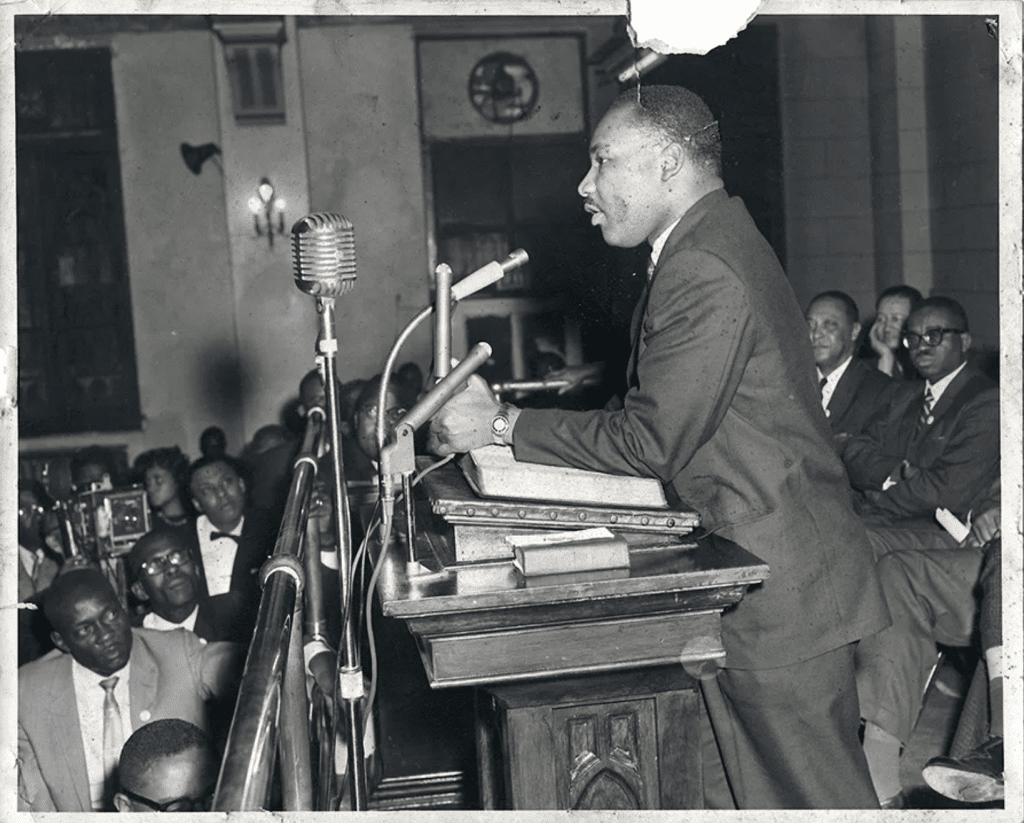
STONE TEMPLE BAPTIST CHURCH
I visited the historic Stone Temple Missionary Baptist Church in North Lawndale for the first time on Oct. 19 — the lone Black tourist in the church for the annual Open House Chicago architecture tour.
It was a Sunday, and service was happening, so we were only allowed to gawk from the synagogue’s old balcony. Below, a visiting preacher’s voice thundered in a moment so intense I thought it might rattle some of the white visitors tracing the gilded capitals and Hebrew inscriptions with their eyes, pausing over placards and photographs that link the space to Martin Luther King Jr., who was close to the church’s founding pastor, the Rev. J. M. Stone.
Considering the weight of all this history — the grainy monochrome photos of King and Stone now carrying the aura of the Sphinx — it’s easy to be fooled into thinking it all happened inevitably. But it takes reading, and reading certain books, to realize that, to the contrary, this history emerged from a highly contingent, accidental, and messy present.
A 40-year-old today stands as close to King’s assassination as to the election of the first Black president. That fact has been in my head since that Sunday — the realization that the movement King embodied isn’t ancient history but a living, unstable story still unfolding through people very much like us.
The journalist John A. Williams understood this well. In The King God Didn’t Save, published in 1970, he stripped away the glow of sainthood to show us the human King and the unique moment that produced him — fragile, divided, and uncertain.
Williams quotes the influential Black journalist Louis E. Lomax, a close King collaborator, who said it’s no “detraction from Martin to say that but for the news media he would have remained an unsung clergyman.” Major white media outlets were starting to hire Black journalists for the first time and beginning to master the distracted attention economy we now take for granted. Back then, television was still a novelty, and it could be used by King and other movement leaders to great tactical effect, particularly when stories had clear heroes and villains.
Had Montgomery’s leaders been a little smarter and hip to the new technology’s power to persuade, we might be as oblivious to King and the famous boycott as we are to its Louisiana predecessor. Two years before King and Rosa Parks became the face of U.S. civil rights, the Rev. T. J. Jemison — like King, a “charismatic minister and newcomer to the city” — led a Baton Rouge bus boycott that resulted in the city agreeing to “provide Black patrons with better — yet still segregated — seating arrangements.”
In Montgomery, the boycott leaders’ demands were just as conservative. Black riders were just asking not to have their heads knocked off by indignant drivers. They also wanted Black drivers hired on routes through all-Black neighborhoods and first-come, first-served seating within the segregated section of buses, Glenn Eskew writes in his 1997 study But for Birmingham.
In effect, boycott leaders were asking “for what they had been getting all along, with minor modifications,” Williams writes. But “the stupidity and short-sightedness of the Montgomery city officials forced the MIA [the Montgomery Improvement Association] to take its case to higher courts, and on Nov. 13, 1956, the U.S. Supreme Court upheld the decision of the U.S. District Court that Alabama’s state and local laws, which embodied racial segregation throughout public accommodations, were unconstitutional.
“So, ironically, the segregationists helped to create Martin King, the public man.”
After King’s success in Montgomery, activists like Bayard Rustin and Ella Baker urged him and his fellow ministers to pivot from the MIA to form the Southern Christian Leadership Conference (SCLC). The successor group was formed in 1957 to support other local civil rights groups across the nation that were engaging in direct-action protests.
For the next few years, however, the SCLC floundered. There weren’t many direct-action protests happening nationwide. What’s more, the group of preachers was feuding with the NAACP, the granddaddy of the civil-rights organizations, whose leader, Roy Wilkins, was more than a little jealous of King. And, as Williams observes, King was a poor organizer whose ego couldn’t accommodate equals who might outshine him. It was all a hot mess. Across the country, the “Black masses” — those not part of the elite or middle class — ignored both the NAACP and the SCLC (not unlike today).
And then Birmingham called.
Despite being on the cover of Time magazine, the SCLC’s failures had caused King’s reputation to take a serious hit. When Birmingham activist Rev. Fred Shuttlesworth called asking the SCLC to help them fight for equal rights in public accommodations in the small city, King felt he had no choice but to go and attempt to restore his name. Once again, King and the movement encountered the heroic villainy of stupid racists.
This time, the cruelty took the form of Birmingham Public Safety Commissioner Eugene “Bull” Connor, whose stupidity and zealotry led him to unleash dogs and fire hoses on women and children. It proved spectacular political theater and softened the ground for the passage of the Civil Rights Act of 1964.
Had Connor been half as smart or as slick as Old Man Daley — who outmaneuvered King during his Chicago campaign, now largely deemed a failure by historians — we might not know King’s name today.
President John F. Kennedy once quipped that Connor “has done more for civil rights than almost anybody else.” That may, indeed, be the case.
Kennedy may have meant it as a joke, but it lands closer to a prophecy. So much of what we call progress has depended on the arrogance, the blindness, or the sheer stupidity of men like Bull Connor — men too small-minded to imagine the scale of the change they were helping to bring about. History keeps stumbling forward on such accidents of character.
I thought about that as I stood in Stone Temple’s balcony, looking down at the congregation swaying to the preacher’s voice, the same way they must have swayed when King preached there nearly 60 years ago. The tourists beside me were still snapping photos of the gold-leaf capitals and Hebrew inscriptions, but below them, the sound of praise was shaking the floorboards — the living city humming alongside the story we think we already know.
That’s the danger of history told too neatly: it hardens into architecture, into plaques and bullet points, when in truth it’s still breathing, still accidental, still waiting for someone, however imperfect, to answer the next call.
What This Is

The Quiet Before is a column about attention, thought, and the demystification of history and everyday life — and about the slow, communal work of reading and writing, the necessary and sufficient conditions for meaningful social change. It lingers in the spaces where reflection still matters — where taking time to think is its own quiet form of resistance.
Related Articles

OPINION: Halt the Current CPS CEO Selection Process and Install Dr. Macquline King as CEO Through the School Year
“This is not a casual disagreement over preference or personality”
OPINION: Eight Schools. One Purpose. Elevating the 8th District.
Shantel Franklin, a candidate for 8th District state representative, on her journey from homelessness to the campaign trail