Supreme Court’s Latest Voting Rights Decision Continues Long Rollback of Civil Rights Era Protections
Rep. Danny K. Davis says the recent Louisiana v. Callais decision ‘further erodes critical safeguards that protect voters’
Many civil rights advocates are viewing the U.S. Supreme Court’s recent decision in Louisiana v. Callais as the latest step in a decades-long effort to weaken the Voting Rights Act of 1965 — one of the most important laws produced by the Civil Rights Movement.
The ruling centers on Louisiana’s congressional map and whether the state could legally create a second majority-Black congressional district after years of legal challenges over racial representation. In a 6-3 decision, the Court’s conservative majority ruled against the map, arguing that race cannot be used too heavily when drawing political boundaries, even when states say they are trying to comply with the Voting Rights Act.
The decision highlights a deep philosophical divide that has shaped the Court’s voting-rights rulings for years.
Conservative justices have increasingly argued that America has changed dramatically since the Jim Crow era and that extraordinary federal oversight of elections is no longer necessary. Liberal justices, meanwhile, argue that racial discrimination in voting never disappeared — it simply evolved into more subtle forms.
No one expressed that tension more clearly than the late Justice Ruth Bader Ginsburg in her famous dissent from the Court’s 2013 ruling in Shelby County v. Holder.
“Throwing out preclearance when it has worked and is continuing to work to stop discriminatory changes,” Ginsburg wrote, “is like throwing away your umbrella in a rainstorm because you are not getting wet.”
For many voting-rights advocates, that quote has become a warning about what has unfolded over the last decade.
To understand why the Callais decision matters, it helps to understand how the Voting Rights Act has gradually been weakened over time.
When Congress passed the law in 1965, it gave the federal government powerful tools to stop racial discrimination in elections, especially in Southern states with long histories of suppressing Black voters.
One of the law’s strongest provisions was something called “preclearance.” Under preclearance, certain states and counties with histories of discrimination had to get approval from the federal government before changing election laws, polling places, district maps, or voting procedures.
For decades, civil rights groups argued that preclearance stopped countless discriminatory policies before they could take effect.
But over time, the Supreme Court’s conservative wing began narrowing those protections.
In the 1980 case City of Mobile v. Bolden, the Court made it harder to challenge discriminatory election systems by requiring proof of intentional racism rather than simply discriminatory outcomes. Congress later responded by strengthening the Voting Rights Act through amendments.
Then, during the 1990s, the Court began scrutinizing majority-Black voting districts more aggressively in cases like Shaw v. Reno, arguing that race could not become the dominant factor in drawing districts.
The biggest turning point came in 2013 with Shelby County v. Holder. In that case, the Court struck down the formula used to determine which states had to follow preclearance rules. Without that formula, preclearance effectively stopped functioning.
Writing for the majority, Chief Justice John Roberts argued that conditions in the South had improved enough that the federal government could no longer treat certain states differently based on decades-old data.
Civil rights organizations strongly disagreed, arguing that the ruling opened the door for a wave of restrictive voting laws and aggressive redistricting efforts.
In the years after Shelby, many states passed stricter voter ID laws, reduced polling locations, changed mail voting rules, or redrew districts in ways critics said diluted Black political power.
The Court continued down that path in 2021 with Brnovich v. Democratic National Committee, which made it harder to challenge voting restrictions under another section of the Voting Rights Act.
Then came Louisiana v. Callais.
Supporters of Louisiana’s map argued the state was trying to comply with previous Voting Rights Act rulings by creating fairer representation for Black voters in a state where African Americans make up roughly one-third of the population.
But the Court’s conservative majority said the map relied too heavily on race and therefore violated constitutional principles.
Critics say the decision could make it significantly harder to create or preserve majority-Black districts moving forward — especially across the South.
For conservatives, these rulings represent a move toward what they call “colorblind” constitutional principles and equal treatment under the law.
For liberals and civil rights advocates, however, the Court is dismantling protections that remain necessary because racial inequality in voting and representation still exists.
The United States Supreme Court has narrowed parts of the Voting Rights Act of 1965, a landmark statute introduced during the civil rights era to prohibit racial discrimination in voting. The ruling, Louisiana v. Callais, announced on April 29, makes it harder to challenge redistricting plans because they are racially discriminatory.
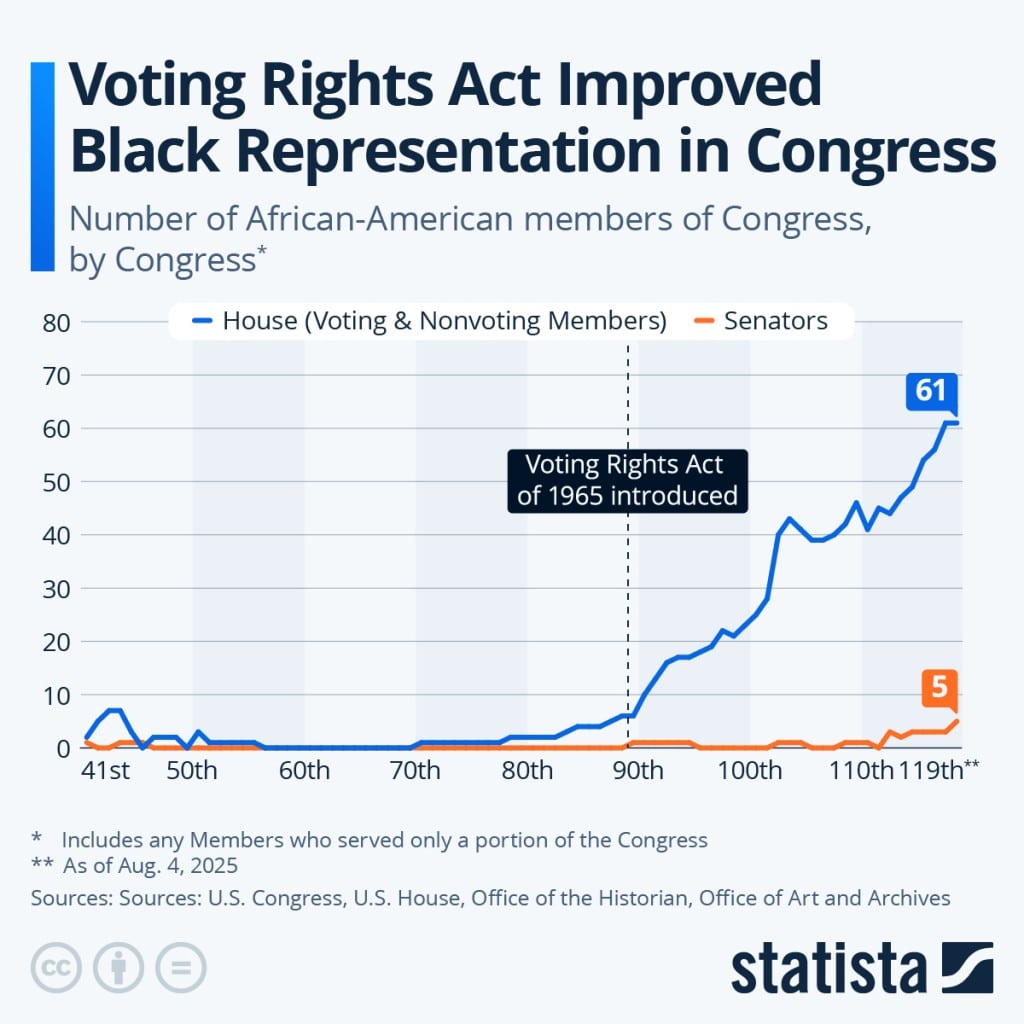
The following chart shows how Black representation in Congress increased significantly after the Voting Rights Act was introduced in 1965. At the start of the 89th Congress, there were just six African American members of the House. This figure more than tripled to 21 by the 99th Congress in 1985, including 20 representatives and one non-voting delegate. Representation has continued to rise, reaching 61 African American members of the House at the start of the 119th Congress in 2025, along with five African American senators – the highest number recorded at the beginning of a Congress in the Senate.
While progress has been made and the 119th Congress is the most racially and ethnically diverse in U.S. history, representation still does not reflect the broader population. This is especially evident in the Senate, where five of 100 senators are African American, compared with roughly 14 percent of the U.S. population identifying as Black or African American. Critics of the ruling warn that the erosion of the Voting Rights Act could reverse the gains in minority representation achieved in recent decades.
Congressman Davis calls the decision a ‘serious blow’
Congressman Davis’ April 30 statement on the Louisiana v. Callais decision:
The Supreme Court’s decision issued today is a serious blow to the principle that every American—regardless of race, background, or zip code—deserves equal protection under the law when it comes to voting rights. This ruling threatens to further erode critical safeguards that protect voters, particularly Black communities and other minority groups, and opens the door to unfair congressional redistricting that dilutes the voices of the many in favor of the few.
At a time when our nation should be strengthening access to the ballot, this decision moves us backward. It deepens divisions, undermines confidence in our democratic institutions, and risks making hard-won civil rights protections meaningless.
I stand in strong disagreement with this ruling and join the NAACP, the American Civil Liberties Union, and civil rights advocates across the country in calling for immediate action. Congress must act to restore and strengthen voting rights protections and ensure that every voice is heard and every vote counts.
Our democracy depends on it.
Related Articles
15th District Council Members Pitch Community Justice Alliance to Resolve Low-Level Conflicts, Build Trust
Pilot proposal would train residents, police officers, and council members in mediation, restorative justice, and racial healing practices
Mayor Brandon Johnson’s Budget Dealt Blow After Failing in Committee, but What’s in It?
The City Council’s Finance Committee vote underscores divisions over head tax, cloud tax hikes, and citywide cost pressures

Illinois Restoring Full SNAP Benefits After Shutdown Ends
All recipients expected to receive November aid by Nov. 20