Artist Hebru Brantley Visits Lil Mama’s West Side Home
The Chicago artist saw his Austin sculpture in person for the first time and met a young West Sider dressed as his soaring character.
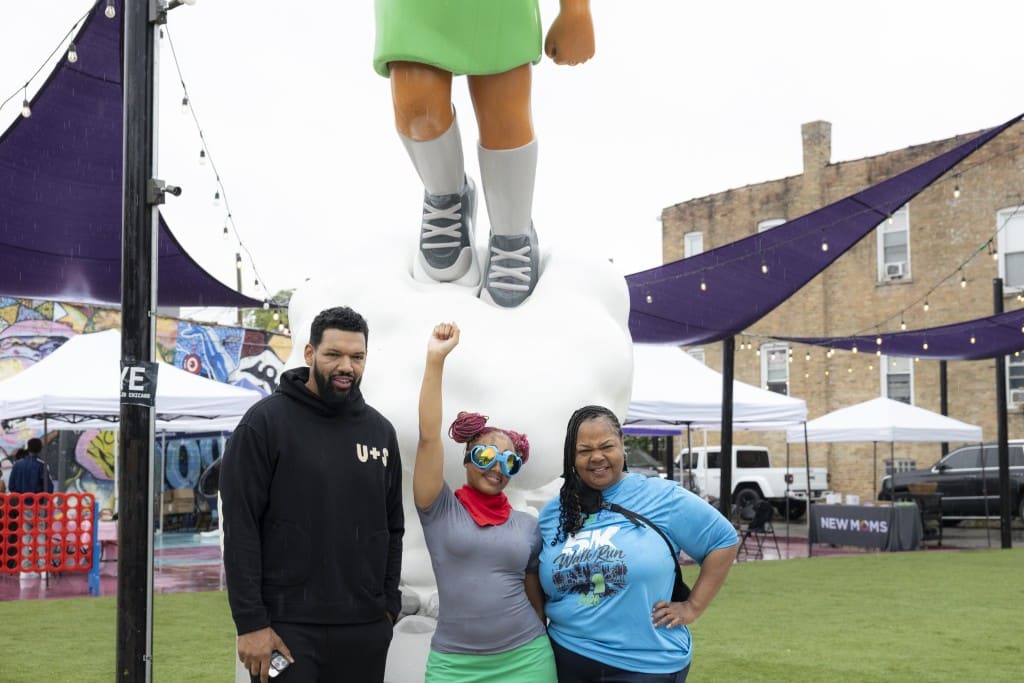
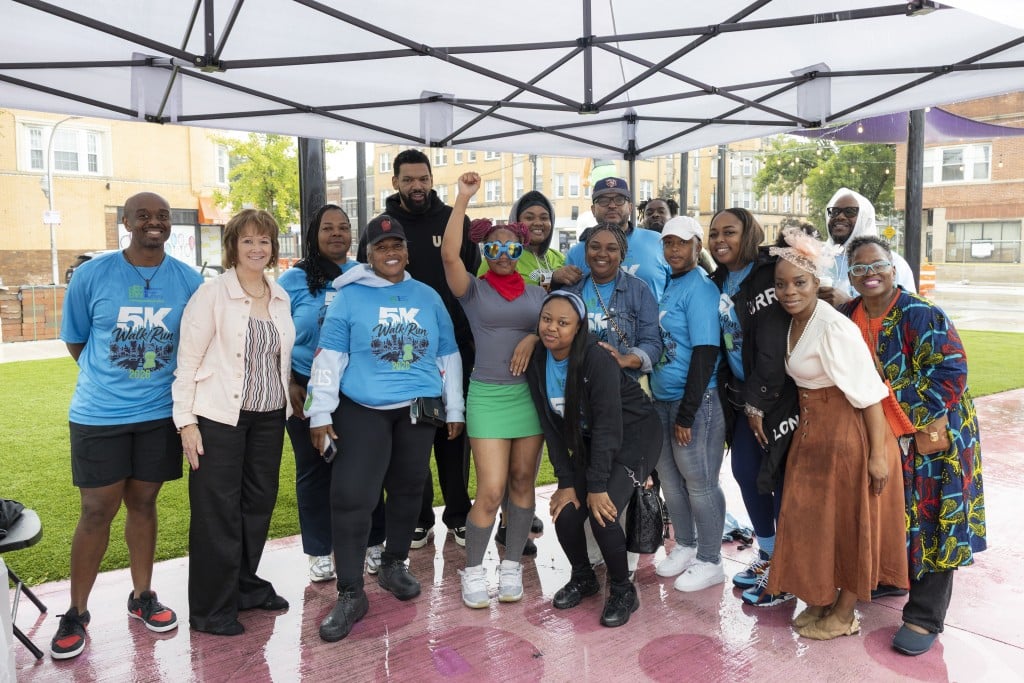
As heavy rainfall pelted the tent covering his 6-foot-8-inch frame, world-famous artist Hebru Brantley took in the soggy sights and sounds of a West Side Saturday. A man running in the Austin 5K sacrificed a few breaths to show the artist some love.
“Hebru!” the man shouted while striding toward Cicero.
Soon afterward, 18-year-old Prishyia Moore showed up dressed like Brantley’s larger-than-life statue that anchors the POPCourts! community plaza on the corner of Lockwood and Chicago avenues.
Moore, a West Side resident, wore a costume inspired by Fantastic Flying Lil Mama: a young girl in flight goggles and a bandana, rising from a cloud with her fist raised. Moore’s grandmother, Tonya Grisby, is Westside Health Authority’s re-entry director. Earlier this year, Arewa Ekua, a community organizer with Austin Coming Together, selected Moore to portray the character at a community event.
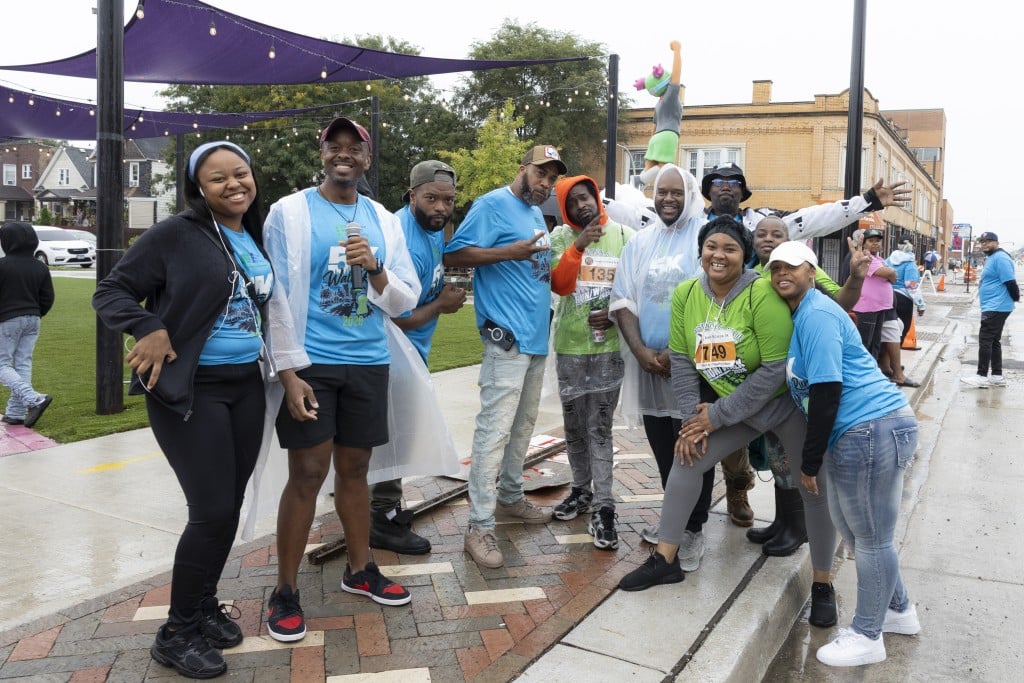
Brantley was in Austin on Saturday, Sept. 19, for a ribbon-cutting celebrating the sculpture, which was unveiled in 2024. The event coincided with the Austin P.O.W.E.R. 5K on Chicago Avenue.
The city’s Department of Cultural Affairs and Special Events funded the work. DCASE Commissioner Kenya Merritt joined the celebration and recognized Westside Health Authority CEO Morris Reed and property manager Rosie Dawson during her remarks.
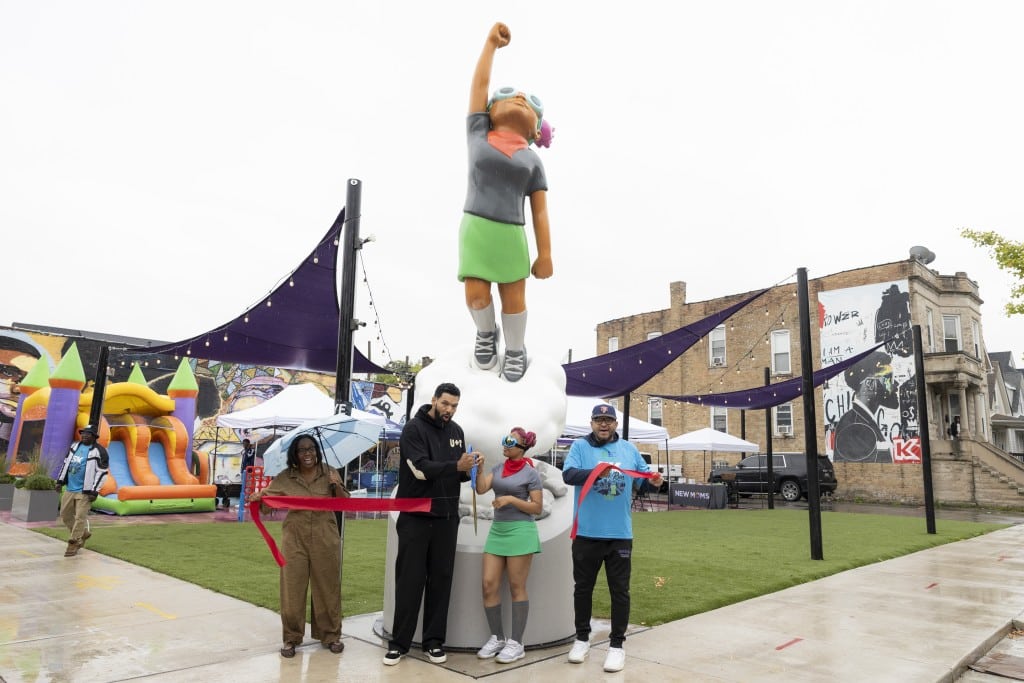
“I live in Austin, so to be able to come out on a Saturday and join one another in community and hang out—unfortunately, somebody didn’t get the memo about the rain, but that’s okay,” she said. “We’re still here to celebrate and to be with one another.”
“This space is for the public,” said Reed, referencing the PopCourt . “We want you to
Brantley said the visit was his first chance to see Fantastic Flying Lil Mama in person. He had designed the sculpture and helped with its manufacturing in Chicago, but had yet to stand beside it on Chicago Avenue.
“I love it,” he said.
Lil Mama is one of the young protagonists who recur throughout Brantley’s art, alongside FlyBoy, a character inspired by the Tuskegee Airmen. He said he uses the characters to convey empowerment, particularly within a community. Here, that idea takes the form of a girl blasting skyward.
“The idea of a massive young lady taking off, blasting off—it’s a bit empowering,” Brantley said. He wants young people who see her to “chase those goals, chase those dreams” without fear.
The sculpture is made of fiberglass with a metal structure inside to help it endure Chicago winters, he said. It has also given neighborhood children something to make art about themselves.
Soon after the sculpture’s unveiling in 2024, second through fourth graders at Henry H. Nash Elementary School of Fine and Performing Arts painted portraits of their personal heroes for “You’re My Hero,” a pop-up gallery at Urban Essentials Coffee Café across Chicago Avenue. The students’ paintings were displayed with explanations in their own words of why they chose their subjects, Block Club Chicago reported.
At Saturday’s ceremony, Merritt spoke about what it meant to have a work of public art reflecting young women in the neighborhood. She thanked the community partners who helped make the gathering possible, including Westside Health Authority.
Brantley connected the moment to his own childhood on Chicago’s South Side. Murals along neighborhood corridors helped inspire him to become an artist, he told the crowd, at a time when he did not often see a reflection of who he hoped to be.
“Being able to give back, and also look forward and help beautify, help change a neighborhood with my creation, is always a blessing,” he said.
Then he noticed Moore near the back of the gathering, dressed as the character he had come to celebrate. Brantley pointed her out and told the crowd that inspiration travels in both directions.
“I get inspired from y’all just as much as, you know, I inspire,” he said.
Related Articles

Your 2026 West Side Voter Guide
A tool for West Siders to learn more about the upcoming Chicago school board elections

Meet the Candidates Running for Districts 5A and 5B
Five candidates are seeking to represent the two West Side districts

Meet the Candidates Running for Board President
Three candidates are running for the pivotal top seat on the Chicago school board