
School Closings Become a Dividing Line in School Board Races
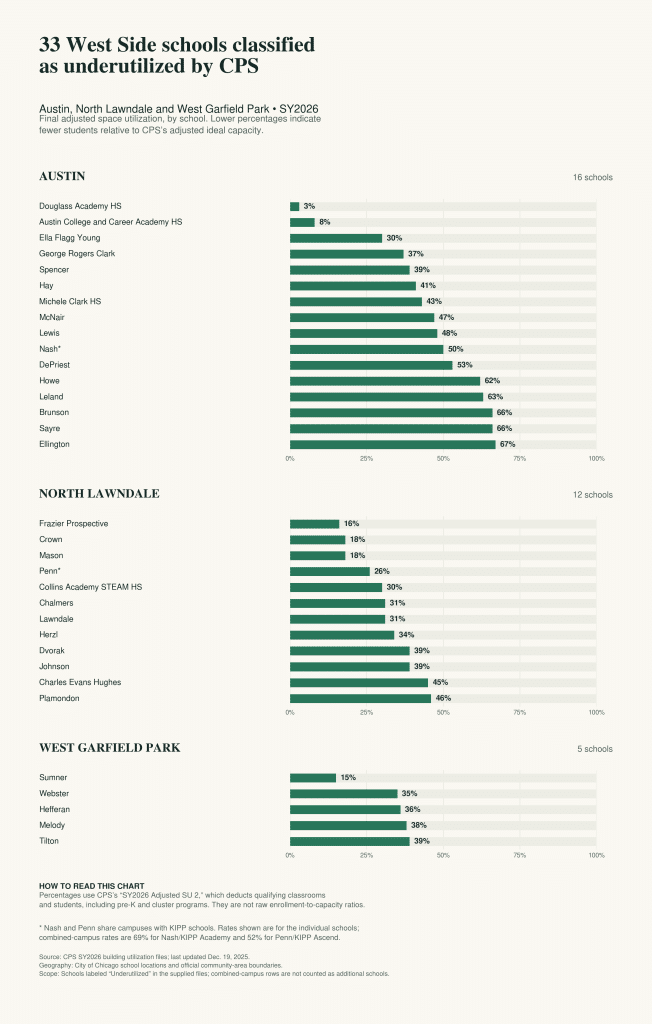
Thirty-three schools in Austin, North Lawndale and West Garfield Park were classified as underutilized last school year. Enrollment at schools across those communities fell another 4% this fall

What should Chicago do with schools that have room for more students?
That question is dividing candidates in the upcoming school board elections—and carries particular weight on the West Side, where declining enrollment and the prospect of school closures have consequences for students, families and entire neighborhoods.
An analysis by The Culture found that Chicago Public Schools classified 33 schools in Austin, North Lawndale and West Garfield Park as underutilized in its 2025–26 building utilization report.
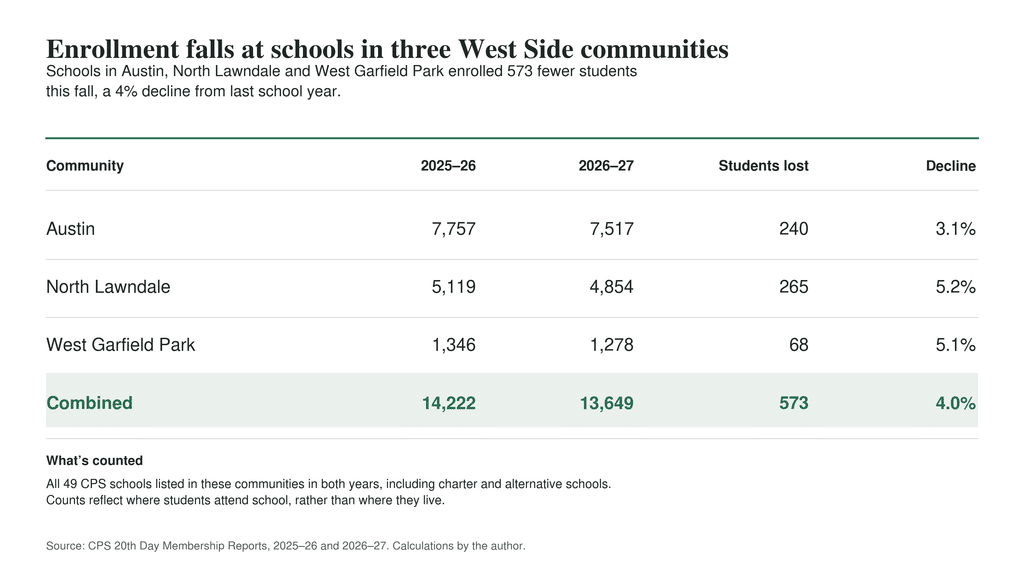
Meanwhile, enrollment across all CPS schools in those three communities dropped from 14,222 last school year to 13,649 this fall—a loss of 573 students, or 4%.
Here is what the data shows, what the candidates have said and what voters should know.
Why is this an election issue now?
The candidates elected in November will help determine how CPS responds to declining enrollment after the district’s current school-closing moratorium ends.
In September 2024, the Chicago Board of Education adopted a resolution prohibiting closures, consolidations and phase-outs of district-managed schools through the 2026–27 school year. The resolution does not extend the same protections to charter or contract schools.
The debate is already underway. Before the Sept. 24 board meeting, board members Michilla “Kyla” Blaise and Karen Zaccor joined school board president candidate Hilario Dominguez and other advocates at a press conference calling for an extension of the moratorium, Board Rule reported.
Shannon Bennett, executive director of the Kenwood Oakland Community Organization, said his organization would ask candidates to sign a pledge opposing school closures.
What does “underutilized” mean?
CPS generally classifies a school as underutilized when enrollment falls below 70% of its ideal capacity under the district’s space utilization standards.
The final adjusted rates used in this analysis account for qualifying classroom uses and student populations, including prekindergarten and cluster programs for students with disabilities.
The designation measures enrollment relative to capacity. It does not, by itself, establish the quality of instruction, the condition of a building or whether closing a school would improve students’ education.
It also does not mean a school is scheduled to close.
How many schools are underutilized in these three communities?
The Culture identified 33 schools in the supplied CPS utilization files:
- Austin: 16 schools
- North Lawndale: 12 schools
- West Garfield Park: five schools
These classifications cover the 2025–26 school year, and the files were last updated Dec. 19, 2025.
The count refers to schools rather than separate buildings. Penn Elementary in North Lawndale and Nash Elementary in Austin share campuses with KIPP schools. Both combined campuses were also classified as underutilized, but those campus entries were not counted as additional schools.
Across the main utilization file, CPS classified 255 of 476 listed schools—about 54%—as underutilized. That file excludes specialty, early childhood and options schools; co-located schools are also detailed in a separate file.
The accompanying charts show individual schools and their adjusted utilization rates.
Is enrollment still falling?
Yes. Comparing CPS’s official 20th-day enrollment reports shows declines in all three communities between 2025–26 and 2026–27.
Austin schools lost 240 students, a 3.1% decline. North Lawndale schools lost 265 students, or 5.2%, while West Garfield Park schools lost 68 students, or 5.1%.
Together, enrollment fell 4% across the same 49 schools appearing in both years’ reports. The comparison includes district-run, charter and alternative schools—not just those labeled underutilized.
Enrollment at the 33 underutilized schools fell from 8,886 to 8,456, a loss of 430 students, or 4.8%.
Districtwide, CPS enrolled 304,687 students this fall, down 11,537 from last school year—a decline of approximately 3.6%.
These figures describe enrollment at schools located in the three communities. They do not count all school-age children who live there, some of whom attend schools elsewhere.
What have the candidates for school board president said?
The three active candidates have taken different positions on whether closures should remain an option.
In a questionnaire produced by WBEZ, the Chicago Sun-Times, Chalkbeat and Block Club Chicago, candidates were asked whether they support closing schools for any reason. Victor Henderson answered yes, Jessica Biggs selected neither and Hilario Dominguez answered no.
Victor Henderson described closures as an extraordinary last resort requiring evidence, community participation and a transition plan.
“Only as an extraordinary last resort. Any closure must be based on clear educational, safety and financial evidence and include meaningful parental and community participation and a credible transition plan that improves students’ opportunities. Closure should never be imposed merely to balance a budget.”
Jessica Biggs emphasized the damage closures can cause while leaving open the possibility of addressing enrollment and facility challenges through a community-informed process.
“Closing a school is the last thing we should want for a community. As a principal, I saw 6 nearby schools close in 2013. But the budget pressure is real, and some schools can’t offer the programming kids deserve. We need a plan to tackle facility and enrollment challenges informed by those closest to impacted schools.”
Hilario Dominguez opposed closures, arguing that CPS should strengthen schools and their surrounding communities.
“Research has shown school closures increase violence without reducing costs. The question is how we add to our school communities, not abandon them.”
The differences remained evident at an Oct. 14 candidate forum. According to Chalkbeat’s account, Dominguez supported extending the moratorium and using available space for services such as mental health clinics and food pantries. Henderson said closures must be discussed with communities, while Biggs emphasized community involvement and planning for the future use of buildings before any closure or consolidation.
What have the District 5A candidates said?
LaPamela Williams and Aaron “Jitu” Brown both answered no when asked whether they support closing schools for any reason.
Williams emphasized resource decisions and student opportunity:
“Every decision should begin with one question: Are we using our resources to give every student the best opportunity to succeed? Our responsibility is to invest wisely, strengthen schools and prepare students for their future.”
Brown’s response was direct:
“School closings do not benefit students or educators and are not what I would recommend in anyway.”
The collaborative voter guide also lists Kernetha Jones as a write-in candidate. Its comparison does not list a yes-or-no response from her on school closures.
What have the District 5B candidates said?
Michilla “Kyla” Blaise and Anthony Hargrove both answered no to the school-closing question.
Blaise pointed to her efforts to preserve schools and the consequences closures have for neighborhoods:
“I voted to keep Acero schools open when their leadership tried to close them down.”
She also acknowledged declining birthrates and their effect on enrollment, adding:
“School closings impact the students and the neighboring community negatively so it will always be difficult to close a school.”
Hargrove emphasized investment:
“CPS should strengthen schools, not close them. We must invest resources wisely, improve student outcomes and ensure every neighborhood has access to a high-quality school that prepares students for college, careers and life.”
What should voters ask next?
A position on closures is a starting point. Voters can also ask candidates how they would strengthen schools with declining enrollment, maintain academic and extracurricular programs, and pay for their proposals.
Candidates who would consider closures can be asked what evidence would justify that decision, how students’ safety and educational opportunities would be protected, and what would happen to the buildings left behind.
Candidates who oppose closures can be asked how they would attract and retain students, use available space and sustain programming as enrollment changes.
For families in Austin, North Lawndale and West Garfield Park, those answers will help explain what each candidate’s position would mean beyond Election Day.
About the analysis: The Culture examined CPS’s SY2026 utilization files and compared its 2025–26 and 2026–27 20th-day enrollment reports. The geographic scope is Austin, North Lawndale and West Garfield Park, rather than the entire West Side. Utilization classifications describe last school year; the enrollment comparison includes this fall.
Related Articles

Your 2026 West Side Voter Guide
A tool for West Siders to learn more about the upcoming Chicago school board elections

Meet the Candidates Running for Districts 5A and 5B
Five candidates are seeking to represent the two West Side districts

Meet the Candidates Running for Board President
Three candidates are running for the pivotal top seat on the Chicago school board