
Community Leaders Reflect on Pain, Possibility at ‘Beyond Closure’ Screening in Austin
Documentary traces how residents reclaimed shuttered schools to build new neighborhood assets like the Aspire Center for Workforce Innovation

A new documentary examining how Chicago communities are transforming shuttered public schools into centers of hope, healing, and opportunity drew dozens of community members to the Kehrein Center for the Arts in Austin on Oct. 30.
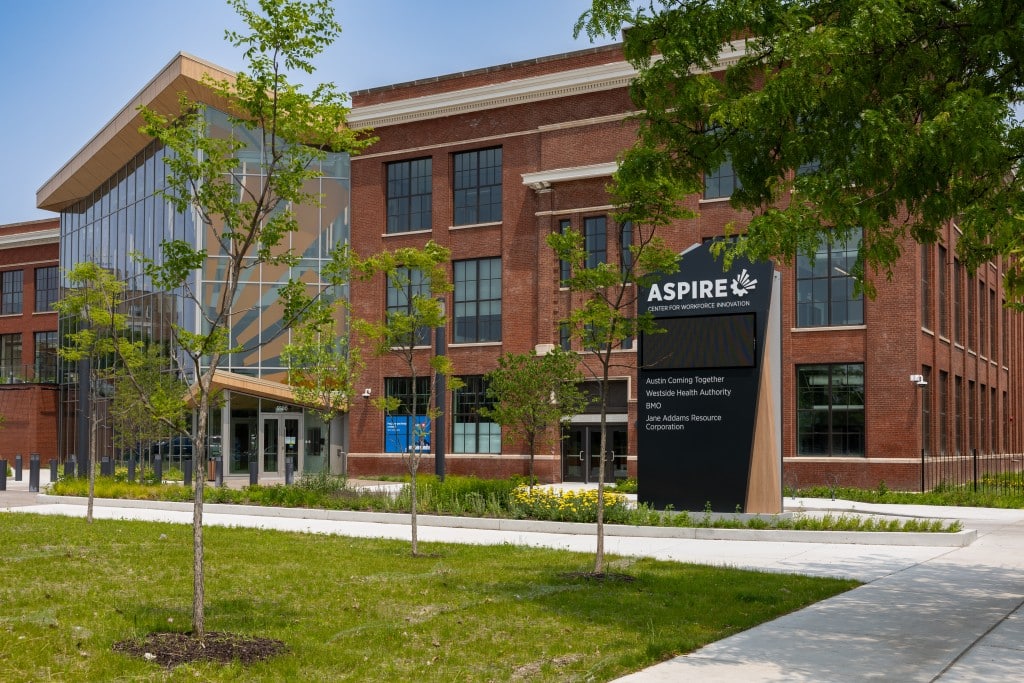
Beyond Closure — produced by On the Real Film and Borderless Studio — chronicles efforts in Austin, Englewood, and Bronzeville to repurpose former Chicago Public Schools buildings after the district’s controversial 2013 mass school closures. The featured sites include the former Emmet Elementary School, now home to the Aspire Center for Community Innovation at 5500 W. Madison St.
The Oct. 30 event included guided tours of the Aspire Center, followed by a screening and a panel discussion with organizers, advocates, and artists who helped drive the decade-long transformation.
The film documents how neighborhood groups reclaimed once-vacant properties such as Emmet, Woods, and Overton, converting them into community hubs, arts incubators, workforce centers, and, in some cases, proposed affordable housing developments. Producers said the work represents a blueprint for other neighborhoods wrestling with disinvestment.
‘People here weren’t having it’
For Austin Coming Together (ACT) Executive Director Darnell Shields, the closing of Emmet was a rupture residents refused to accept.
“When Emmet closed, it wasn’t just an empty building — that left a gap in the heart of the community,” Shields said during the panel. “But as devastating as that was, the thing that was really beautiful is the people here in Austin weren’t having it.”
Shields said local organizers, including those with the nonprofit Westside Health Authority (WHA), began asking what Emmet could become “that works for Austin now.” That question eventually led WHA, under CEO Morris Reed, to marshal the resources to purchase the building and anchor the redevelopment.
Reed said one of the greatest obstacles was convincing people that Austin residents could pull off a project of this scale.
“We’re not rich organizations, so people just didn’t believe,” Reed said. “As Darnell and I were getting resources to achieve this vision, people kept telling us, ‘No, no, no.’”
Reed described his experiences with private developers who attempted to acquire Emmet, believing they were “doing us a favor” by redeveloping the former school for profit. The community pushed back.
“The people said, ‘Hell no! We can do it ourselves,’” Reed said.
First District Cook County Commissioner Tara Stamps, a former CPS teacher, said the film resurfaced the trauma felt by educators and families in 2013.
“What struck me as I was watching the film was the amount of hurt that I still hear,” Stamps said. “So many Chicago Public Schools educators and Chicago Teachers Union members were knee-deep in that fight — getting dragged out of the boardroom, getting stomped on, getting locked up. It was horrible.”
Stamps said the activism against the closures became part of her classroom curriculum, empowering her students to speak at board meetings and articulate what their school meant to them.
Helen Slade, executive director of the Austin-based youth art and design nonprofit Territory, said youth-driven art and design programs give young residents the same sense of agency that community leaders exercised during the fight for Emmet.
“When they get into programs like Territory where they’re being asked to identify problems and come up with solutions, it’s the most amazing experience for them,” Slade said. “That’s the same experience people had when they got together to do the Aspire Center. They said, ‘I have agency in my own neighborhood. I can control the narrative.’”
Producers Paola Aguirre Serrano of Borderless Studio and Erin Babbin of On the Real Film joined moderator Reesheeda Nicole Berry, executive director of the Kehrein Center, in underscoring that the film captures only a slice of the labor behind such projects.
Today, the Aspire Center houses Westside Health Authority, Austin Coming Together, BMO Bank, the Jane Addams Resource Corporation, and the Freedom Center — an example of what community-led redevelopment can yield.
Organizers said they hope Beyond Closure encourages other neighborhoods to view shuttered public assets not as symbols of abandonment, but as raw material for resident-led transformation.
“There is this tension, though, about why we have to create something out of what has become divested in the first place, when other neighborhoods and communities get to have all of those things and not have to sacrifice their schools and other parts of their communities to build and create,” Berry said. “We’ll sit in that tension tonight.”
Related Articles

Artist Hebru Brantley Visits Lil Mama’s West Side Home
The Chicago artist saw his Austin sculpture in person for the first time and met a young West Sider dressed as his soaring character.
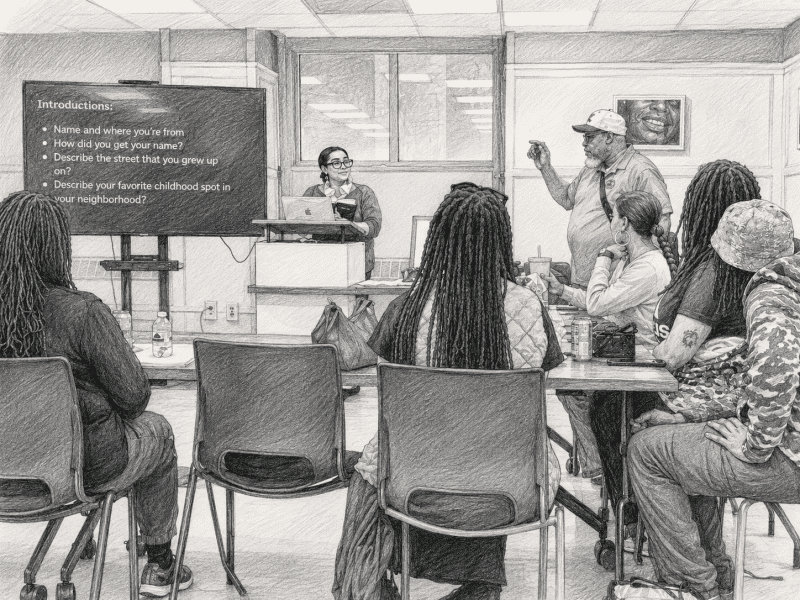
West Siders Learn Tools and Techniques of Preserving Their Own Stories
At a May 9 workshop at Legler, residents explored how oral history can preserve firsthand accounts often missing from mainstream narratives about Black life

Chicago West Community Orchestra Honors City’s Jazz Legacy During International Jazz Day Celebration
Featuring acclaimed vocalist Tammy McCann, the Garfield Park Conservatory performance also showcased local musicians