
West Side Sanctuaries Shine During Open House Chicago
From Austin to North Lawndale, sacred spaces opened their doors during this year’s citywide architecture festival—highlighting the West Side’s growing prominence.
During this year’s Open House Chicago weekend, held Oct. 18-19, a trio of sacred spaces on the West Side offered powerful glimpses into how faith, design, and community intersect. Visitors moved from the soaring Byzantine dome of Assumption Greek Orthodox Church in Austin, to the historically layered sanctuary of Stone Temple Missionary Baptist Church in North Lawndale, to the intimate, monastic chapel of Fraternité Notre Dame, also in Austin—each space revealing a chapter of the West Side’s cultural and architectural story.
This year, the West Side served as a particular point of emphasis for the Chicago Architecture Center’s citywide program. The Aspire Center for Workforce Innovation, housed in the repurposed former Emmet Elementary School in Austin, was named by WBEZ architecture critic Lee Bey as one of his top five must-see sites of the festival. Meanwhile, Starling by Duo, a restored landmark in East Garfield Park, was selected as one of four Open House Chicago neighborhood headquarters, signaling a growing recognition of the West Side as a hub of preservation, reinvention, and place-based storytelling.
Inside Assumption Greek Orthodox Church — 601 S. Central Ave., Austin
With its domed ceilings, gilded capitals, and cascading frescoes of saints and angels, Assumption Greek Orthodox Church radiates the splendor of Byzantine design brought to the West Side. Completed in 1938 and designed by architect P.E. Camburas, the church envelops worshippers in an iconographic world where architecture, geometry, and light converge in praise. Its luminous dome and golden mosaics offer a visual theology of transcendence—an enduring anchor of Orthodox faith and artistry in the heart of Austin.
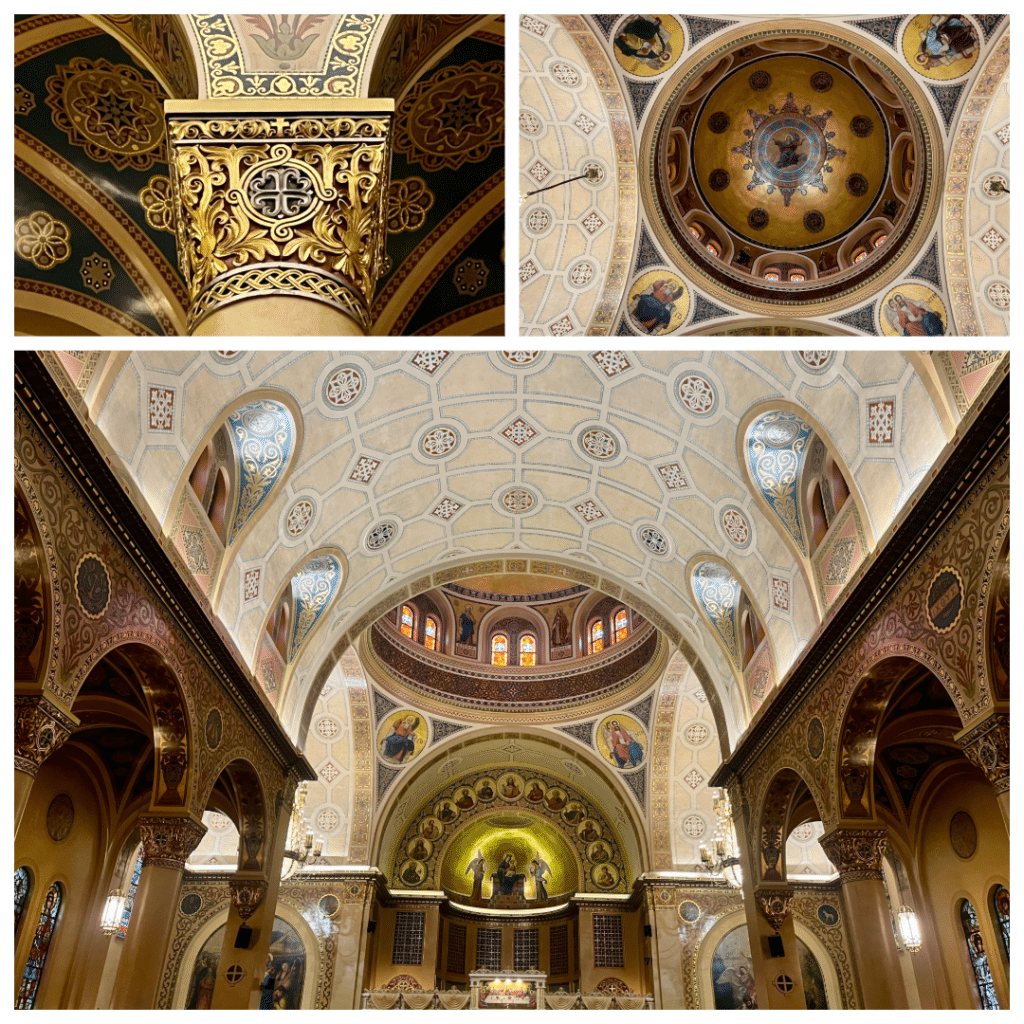
Top Left: Gilded capital detail
A Corinthian-style capital decorated with gold leaf and vine patterns reflects the Byzantine influence found throughout Assumption Greek Orthodox Church. The hand-painted detail shows the craftsmanship that characterizes the church’s 1938 design.
Top Right: Central dome and iconography
The central dome features an image of Christ the Pantocrator, or Ruler of All, surrounded by smaller portraits of prophets and saints. The circular layout, common in Orthodox architecture, focuses attention on the divine figure at the dome’s center.
Bottom: Nave and dome interior
The view from the nave shows the church’s series of arches and domes, completed in 1938 and inspired by Byzantine design. Pale stone, red accents, and painted figures cover the interior, emphasizing the central dome and uniting architecture and iconography in a single visual space.
Inside Fraternité Notre Dame — 502 N. Central Ave., Austin
Inside the chapel of Fraternité Notre Dame—a French monastic order housed in the former Gammon United Methodist Church (built 1899)—traditional Catholic art meets the architectural bones of a 19th-century Protestant sanctuary. The chapel’s Gothic-arched altar, gilded Stations of the Cross, and a statue of St. Martin de Porres reflect a fusion of devotion, heritage, and community service on Chicago’s West Side.
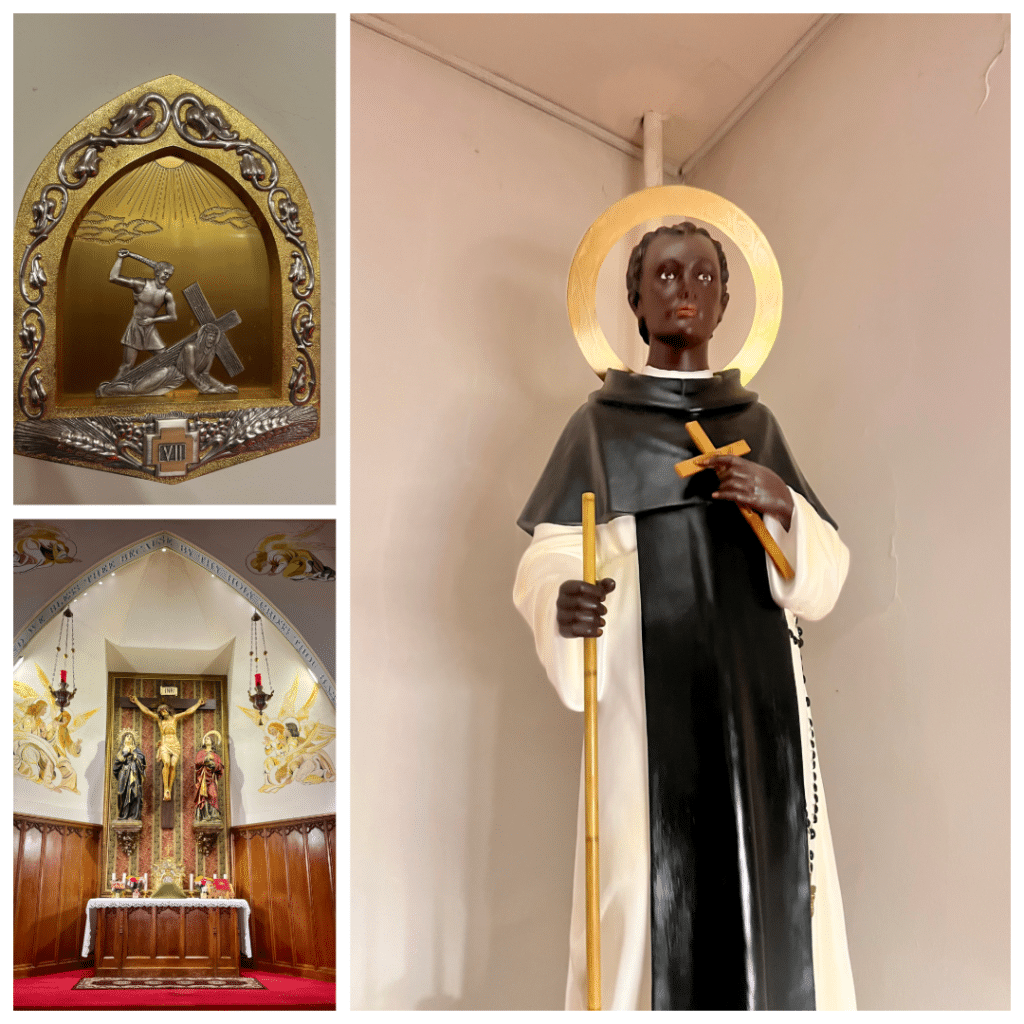
Top Left: The Seventh Station of the Cross
A silver-and-gold relief depicting Christ’s second fall under the cross, one of fourteen Stations lining the chapel walls. Each scene invites meditative prayer within a gilded Gothic frame that mirrors the sanctuary’s architecture.
Bottom Left: Main Altar and Sanctuary
The heart of Fraternité Notre Dame’s chapel centers on a traditional Crucifixion tableau—Christ on the cross with the Virgin Mary and St. John—beneath an inscription reading, “We adore thee, O Christ, and we bless thee, because by thy holy cross thou hast redeemed the world.” The carved wood and painted angels recall European monastic design, transposed to Austin’s neighborhood scale.
Right: Statue of St. Martin de Porres
A serene figure of St. Martin de Porres, the 17th-century Dominican lay brother of African-Peruvian descent, stands in quiet reverence. His presence symbolizes humility, racial unity, and the order’s mission of mercy—embodying the chapel’s blend of art, faith, and social outreach.
Inside Stone Temple Missionary Baptist Church — 3622 W. Douglas Blvd., North Lawndale
Once a Romanian Jewish synagogue and now a cornerstone of Chicago’s Black Baptist tradition, Stone Temple Missionary Baptist Church embodies nearly a century of spiritual continuity and cultural transformation. Built in 1926 and crowned with Stars of David that still gleam through stained glass, the sanctuary fuses Jewish craftsmanship with the expressive warmth of Black gospel worship—a living symbol of North Lawndale’s layered faith history and the neighborhood’s ongoing rebirth.
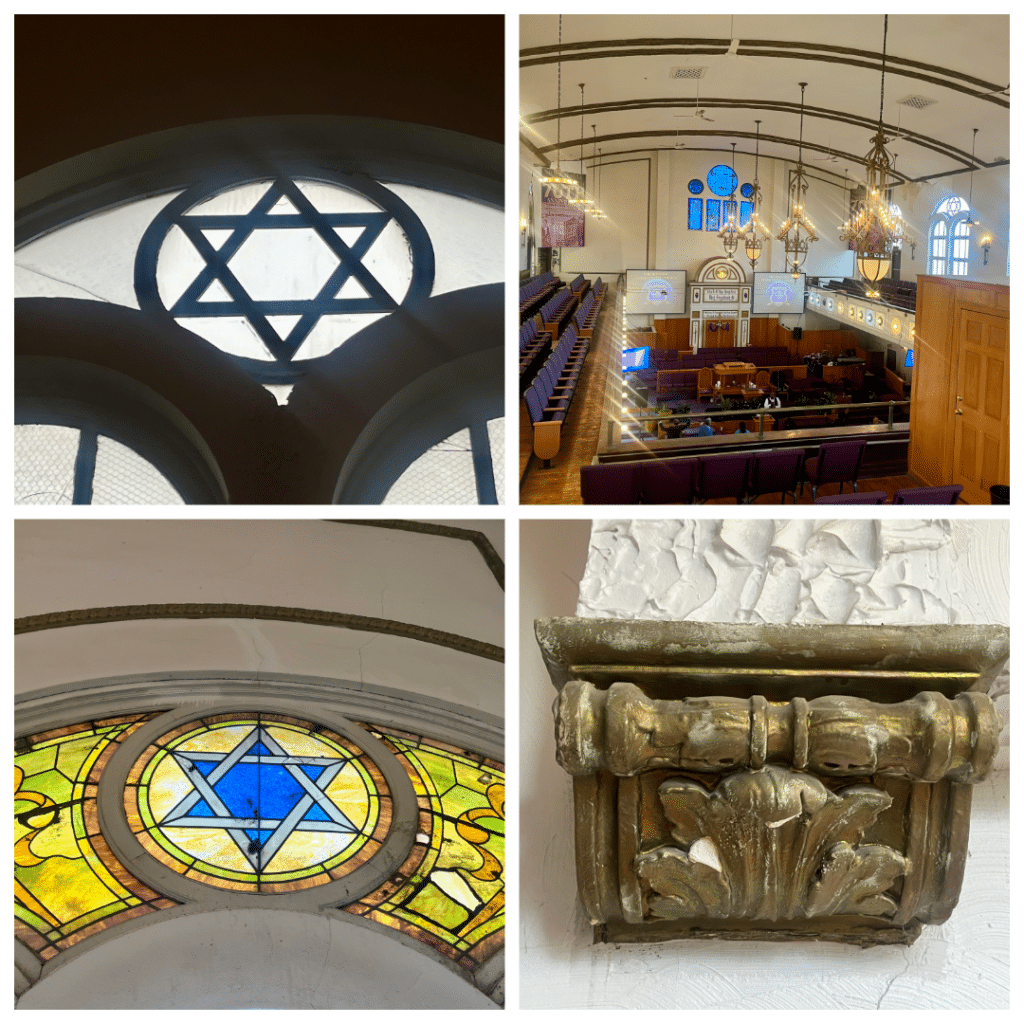
Top Left: Star of David window detail
A six-pointed Star of David, once a symbol of Jewish identity for the First Romanian Congregation, still crowns an upper window inside Stone Temple Missionary Baptist Church. The preserved geometry speaks to the building’s original 1926 synagogue design and its layered sacred history.
Top Right: View of the main sanctuary
The sanctuary of Stone Temple Missionary Baptist Church blends the soaring arches and stained-glass windows of its former synagogue with the vibrant colors and pulpit-centered layout of the Black Baptist tradition. Once home to a Jewish congregation, the space became a cornerstone of Chicago’s civil rights movement after Rev. J.M. Stone acquired it in 1954.
Bottom Left: Stained glass with Star of David
This surviving stained-glass medallion, framed by warm tones of green and gold, features a blue Star of David — a vestige of the church’s early 20th-century Jewish craftsmanship. The congregation has kept the motif intact, honoring both its own faith and the building’s original sacred purpose.
Bottom Right: Carved capital detail
A carved plaster and gilded capital near the sanctuary’s balcony hints at the Romanesque Revival ornamentation of the original 1920s design. Layers of paint and wear trace nearly a century of continuous worship — first by Romanian Jews, later by generations of African American Christians.
Stone Temple’s MLK Legacy
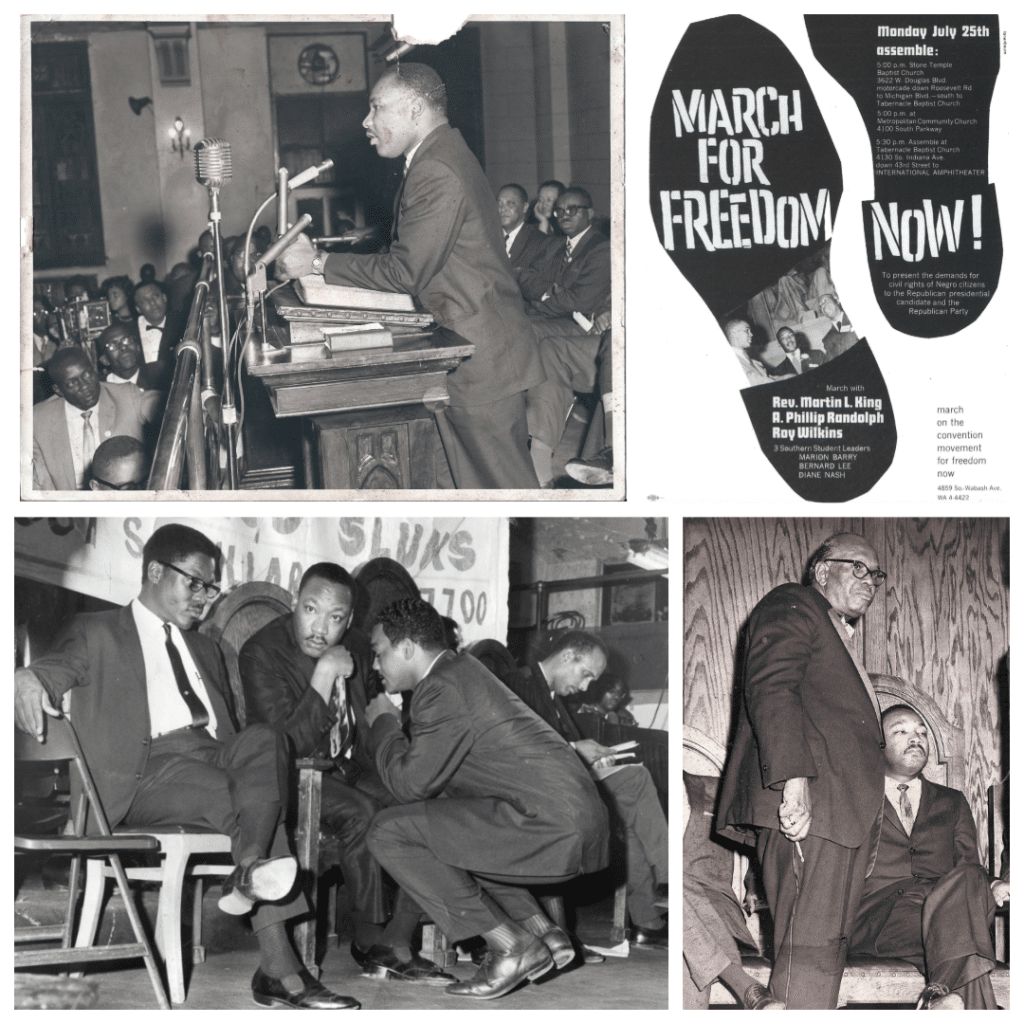
Top Left: Dr. Martin Luther King Jr. speaks at Stone Temple Baptist Church
Dr. Martin Luther King Jr. addresses a packed audience at Stone Temple Missionary Baptist Church in North Lawndale in 1966. The church served as one of the main meeting sites for the Chicago Freedom Movement, where King and other leaders organized campaigns against housing segregation and economic inequality on Chicago’s West Side.
Top Right: March for Freedom flyer
During the 1960 presidential race, King demanded that both parties adopt a civil rights plank. In 1960 Chicago hosted the
National Convention of the Republican Party, and on July 24, 1960, King addressed a rally at Stone Temple, urging the gathering to join his march the following day to the convention headquarters at the International Amphitheatre. The poster at left promotes the march and identifies Stone Temple as one of three churches for the marchers to assemble. (From the Timuel D. Black Jr. collection).
Bottom Left: King and civil rights organizers confer during Chicago Freedom Movement events
Dr. Martin Luther King Jr. (center) confers with local and national organizers during the 1966 Chicago Freedom Movement. Meetings often took place at Stone Temple Baptist Church and other West Side venues where the Southern Christian Leadership Conference coordinated with local activists.
Bottom Right: Rev. J. M. Stone and Dr. Martin Luther King Jr. at Stone Temple
The Rev. J. M. Stone, founder of Stone Temple Missionary Baptist Church, stands beside Dr. King during a 1966 gathering. The church was a cornerstone of King’s Chicago campaign and a vital meeting place for community leaders working toward fair housing reform.
Related Articles

Leadership Successions Announced by Organizations Founded by Prominent West Suburban Bishop
Bishop Claude Porter’s PLCCA and Interfaith Illinois Inc. both got new leadership this month, weeks after his death in December

Austin Collective Action Week to Connect Youth With Civic Engagement, Jobs, and Wellness
A weeklong series of free events, Feb. 16–22, blends civic engagement, career readiness, culture, and wellness for Austin-area youth and families
‘Let Me Share a Poem About a Brotha We All Know’
Jason Ferguson, Marshall High’s Last Track-And-Field Medalist, Fuses Sports and Black History