Spreading Wellness Is Part of the Job
From helping families in a fire to saving lives, Wellness Workers are many times the first to respond to Westsiders in need.
According to a CBS News report, a coach house at 5106 W. Chicago Ave. caught fire on April 18. The structure was destroyed and four people — two adults and two children — were displaced. No injuries were reported.
“The Fire Department said someone maliciously set fire to a mattress outside the coach house, and it spread,” CBS reported.
But that’s not the whole story. A group of Wellness Workers with Westside Health Authority (WHA) were among the first community members on the scene of the fire.
“Everyone got out safe,” said Wellness Worker Monique Almore. “We also brought shirts for the kids because they didn’t have any clothes on and we made sure everyone was safe and gave them resources as well.”
That’s just another day on the job for Monique and her team of roughly a dozen Wellness Workers whose main job is to walk parts of the Westside to make sure people get the help they need, particularly in the form of resource flyers and intake forms — the latter being the first point of contact a person makes before accessing WHA’s many resources and support services.
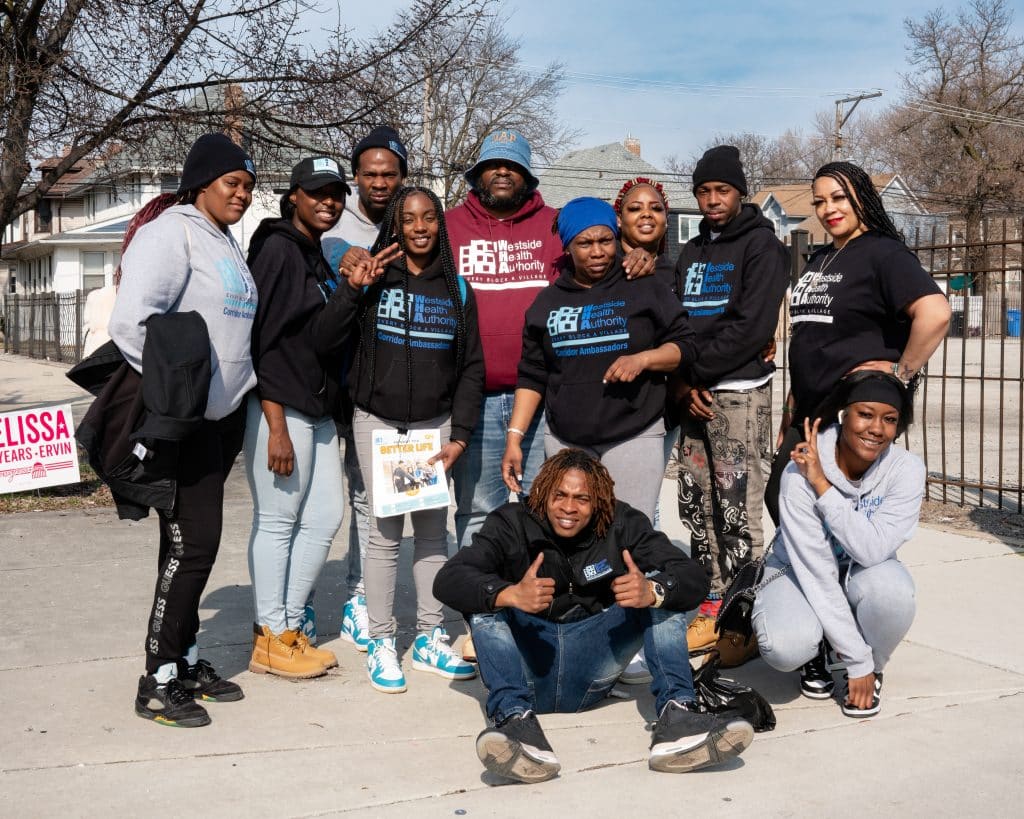
The work can often be thankless, but it’s also invaluable and what makes them some of the most trusted people in their neighborhoods — as our staff photographer, Kenn Cook Jr. (who shadowed the workers one day earlier this year) can attest.
Many of the Wellness Workers are former Corridor Ambassadors, individuals paid to walk busy economic strips throughout the city to build relationships with business owners and residents.
Last year, we interviewed some of those Corridor Ambassadors before they were promoted to Wellness Workers and much of what they said about their Ambassador roles translates to their Wellness work, with one key difference. Now, they have a much larger area — well beyond one or two corridors — where they can spread their positive energy.
Some of their stories

The people are more responsive and respect what we’re doing. When we first started, people were kind of standoffish or didn’t know who we were and what we do. Now we are familiar faces in the neighborhood, so they look forward to seeing us every day, and they we we’ll be out there with fliers. They might know someone who might need resources and they refer them to us.
— Monique Almore

My supervisor [Joseph Green], I guess he felt like I was the one for this job, so he asked me did I want to [be a Wellness Worker] or did I still want to be an Ambassador. I felt like I should be moved up.
It’s almost the same, but with community wellness we do a little bit more, as we’re moving around more, moving to all of the corridors instead of staying on one corridor. We’re able to see new things, meet new people, engage with new people such as churches and schools.
We’ve been in tune with people who try to turn the community around. We’ve engaged with more and more business owners and saw what they think of our neighborhood, what would be a good idea for this neighborhood in particular.
You might have a tore-down lot or something, they might want to put up a pop-lot where you can have things for the community. We can tell our boss [Green], and if he has anything that he can help with, he helps.
— Kaneisha Dyer

I grew up in Yazoo, Miss., a small town. I came up here two years ago. My mom was up here on hospice. I worked construction [in Mississippi] and I can remember that day like it was yesterday. It was 12 o’clock. I was doing a back deck, and I got the call and they said you got to get to Chicago immediately. Your mom’s got three months to live.
I was unemployed and I was desperately in need of a job. I ended up getting a job at Dollar General and two weeks later Joseph called and told me I got the [Ambassador] job.
It was a blessing. I got a chance to meet a lot of new people. When I first came up here, I was kind of nervous and didn’t really know anybody. I was kind of scared to even walk the corridor down Chicago Avenue. By me just walking up and down the corridor, now it’s like everybody knows me. They look out for me. I know over 100 people on Chicago Avenue. I know all the barbershop people, the store owners.
We pass out fliers on resources and check on businesses. Sometimes we may even have to report crime. I’ve been trained to do Narcan [an opioid overdose antidote]. I actually performed it once. My house is right off the avenue, and I was going home and I saw a guy laid back with his eyes rolled. First, I called 911 and then I gave him two shots of Narcan and pressed down on his chest like they told me and waited until the ambulance came and saved his life. I know a couple of guys on Madison Street who did the same thing.
— Jerry Dent
Related Articles

Leadership Successions Announced by Organizations Founded by Prominent West Suburban Bishop
Bishop Claude Porter’s PLCCA and Interfaith Illinois Inc. both got new leadership this month, weeks after his death in December

West Siders Are Canceling TikTok Due to New Privacy Concerns, Fears of ‘Shadow Banning’
After the app’s U.S. operations split from its Chinese parent, creators reported sudden drops in reach and raised concerns about privacy, data use, and political speech
Pitmaster Daniel Hammond Schools Austin on the Art of the Perfect Turkey
Chicago pitmaster Daniel Hammond shares holiday-ready techniques for juicy turkey, perfect stuffing, and foolproof barbecue at Austin Town Hall Farmers Market