
Silence Is the Message
Howard Sandifer’s and Joel Hall’s ‘Sweet Freedom Suite,” performed at the Museum of Contemporary Art, was the Juneteenth experience I didn’t know I needed.

Howard Sandifer said he and his wife, Darlene, stayed up all night to watch Nelson Mandela walk with his then-wife, Winnie, out of Victor Verster Prison on the morning of Feb. 11, 1990.
“I’ll never forget how strong and tall he stood,” Sandifer said. “He had been in prison for so many years, but not a bit of bitterness or hate was in him. He was proud and standing tall. Winnie was right with him. And as they progressed through the crowd, they broke into a national dance.”
That moment three decades ago inspired Sandifer to compose “Sweet Freedom Suite,” his transfixing original dance suite choreographed by esteemed Chicago choreographer Joel Hall. The cast of professional dancers was from Hall’s company.
The suite captivated the audience inside the Edlis Neeson Theater at the Museum of Contemporary Art on Juneteenth. We were there to celebrate the 25th anniversary of the Chicago West Community Music Center (CWCMC), the popular Westside music school Howard and Darlene founded. Chicago Mayor Brandon Johnson and his wife, First Lady Stacie Johnson, co-chaired the event and have children in CWCMC.
Hall said the dance suite debuted last year at the Garfield Park Conservatory, where the setting was much more intimate. Dancers Terri Woodall and Dorianne Thomas told me afterward they had to acclimate to the expansive theater’s more impersonal setting. They said Hall’s dance philosophy helped them overcome that darkened chasm between their bodies and the audience.
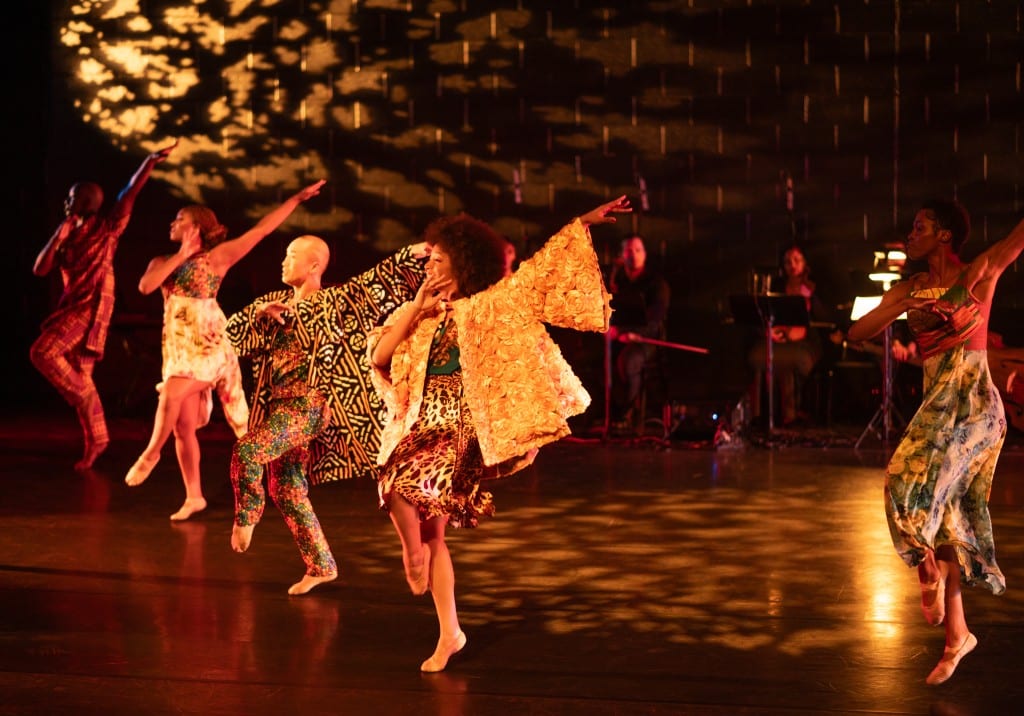
“I often tell my dancers, I don’t want you to dance with your body,” Hall told me after the performance. “Dance with your soul. We need to feel you. That’s very important in anything we do. Stories must be truthful, honest, and meaningful to everybody because everybody in that audience should be moved, whether Black, White, Hispanic, Chinese, or Japanese. It doesn’t matter. Because basically, we’re all the same.”
After witnessing Mandela’s iconic freedom walk three decades ago, Sandifer said he wanted to write “music of freedom” as a tribute to “those who fought and died for it.” The eight-part piece includes tributes to Harriet Tubman, Frederick Douglass, Fannie Lou Hamer, Ruby Bridges, Mandela, and Martin Luther King Jr.
The musical suite presents a wide range of raw emotions that Hall deftly condensed into roughly 30 minutes, much shorter than the two-hour ballet he had intended to choreograph.

“Timing should never be a constraint on your project. It’s just that sometimes you have to compromise to be in sync and on the frequency as Howard because his music is so brilliant,” Hall said.
You can easily spot the famous Black choreographer Alvin Ailey’s influence in “Sweet Freedom Suite.” The piece blends aspects of different genres, including ballet, jazz, and modern dance, in a way reminiscent of Ailey’s.
For instance, I saw and heard echoes of “Revelations,” Ailey’s signature work, in Hall’s physically expressive, emotive choreography (“the brother on the floor, rolling around in chains. It’s real! You’re supposed to feel that!” Hall told me) and in Sandifer’s mesmerizing melting pot of musical genres that span the African diaspora.
When I mentioned this to Hall, he pointed out that he danced at the Alvin Ailey American Dance Theater for about two years in the 1970s when Ailey was still alive. Hall said the experience lingers.
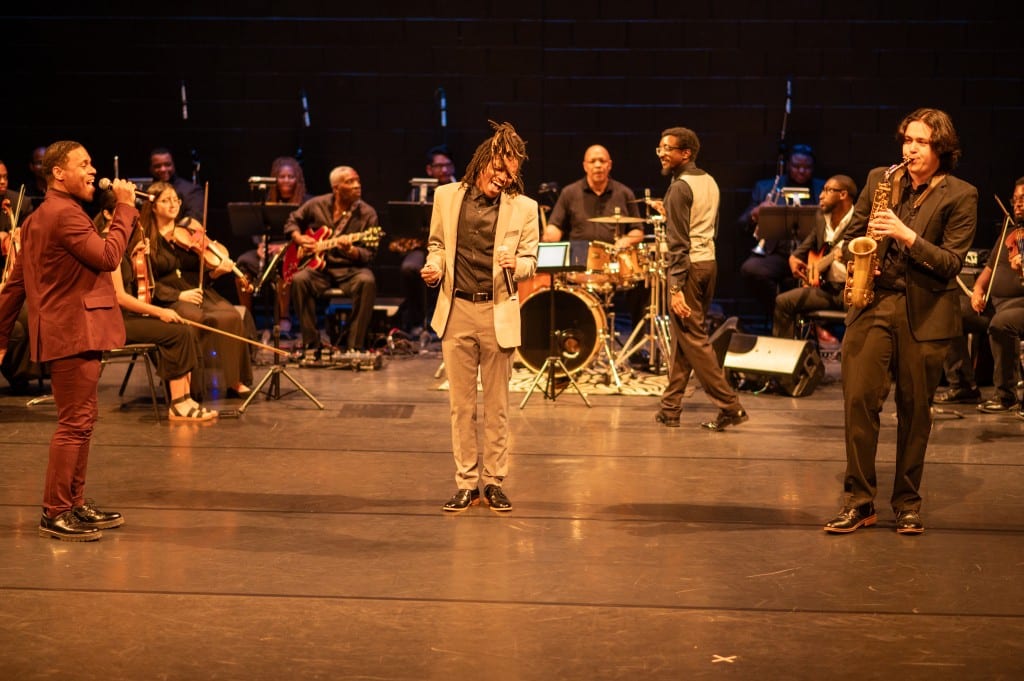
“I was influenced by the way he told stories, and I also learned my technique from Ailey,” Hall said.
Distilling rapture, jubilation, pain, fear, dread, and sorrow into a 30-minute work risks overwhelming the senses. In the hands of Hall and Sandifer, though, this diverse range of emotions works to remarkable effect.
After the suite, which occurred between a musical tribute to philanthropist Helen Zell and student performances, the audience was treated to complimentary access to the museum. I opted to spend most of my time in “Arthur Jafa: Works from the MCA Collection,” an exhibition that runs through March 2, 2025.
Jafa is a Mississippi-born video artist and cinematographer whose work, the MCA writes on its website, “collages images and ideas taken from history, fine art, and popular culture, bringing the viewer into a world of harmonious yet strange sequences and creating a lens configured for the cultural nuances of the Black experience.”
The spiritual experience of seeing “Sweet Freedom Suites” was similar to the transcendence I felt watching Jafa’s “Love is the Message, The Message is Death.” The roughly seven-minute video montage created in 2016 plays over Kanye West’s “Ultralight Beam.”
Jafa patches together seemingly unconnected videos and images — from viral YouTube clips like Charles Ramsey’s famous TV news interview after rescuing Amanda Berry in 2013 (“I knew something was wrong when a little, pretty white girl ran into a Black man’s arms,” Ramsey famously said) to cellphone footage of police brutalizing unarmed Black people to close-ups of the sun’s surface — into a cohesive high-definition digital quilt depicting the beautiful struggle that is Black culture.

“Though the sequences of images seem to defy logic, the frames are cut and spliced rhythmically, producing a choreographed procession of anti-Black violence, mourning, celebration, and intimacy — all inhabiting the immensity and power of the sun,” the MCA explains.
Negative space is the binding force in Jafa’s media and Hall’s movement choreography.
“I’m not really manipulating the images, I’m manipulating the gap between the images,” Jafa says.
And Hall told me that the thread running through “Sweet Freedom Suite” is silence.
“Silence is so important because sometimes silence is movement and music,” Hall said. “You have to listen to your silence. All kinds of things come from that. Your brain evolves. It’s like a meditation.”
For more information on the Chicago West Community Music Center, visit cwcmc.org. For more information on the Museum of Contemporary Art, visit mcachicago.org. Museum admission on Tuesdays is always free for Illinois residents. During the rest of the week, ask about MCA’s reduced admission for students and seniors.
Related Articles
West Side NAACP Calls Community Meeting as CPS CEO Search Faces Scrutiny
The group is urging West Side residents to gather March 31 to talk about transparency and stability as CPS leadership search draws criticism amid uncertainty

Ford’s Suburban Edge Carries Him Past Conyears-Ervin in 7th District Democratic Primary
Franklin wins Ford’s old House seat; Stratton captures Senate primary as Hynes and Preckwinkle notch major Cook County victories
Kindred Civic Arts Forum Opens Women’s History Month With Cole Arthur Riley Conversation in Austin
Author of Black Liturgies and This Here Flesh reflects on Black interior life, spirituality, and emotional survival during a turbulent political moment