
Queen Esther Jackson, the Flood and a Prophecy
For the 83-year-old Westside homeowner, last year’s flooding reminded her of a prediction a precinct captain made in the 1960s.
“If we — and now I mean the relatively conscious whites and the relatively conscious blacks, who must, like lovers, insist on, or create, the consciousness of the others — do not falter in our duty now, we may be able, handful that we are, to end the racial nightmare, and achieve our country, and change the history of the world. If we do not now dare everything, the fulfillment of that prophecy, re-created from the Bible in song by a slave, is upon us: God gave Noah the rainbow sign, No more water, the fire next time!”
— James Baldwin, “The Fire Next Time,” 1963
In 1965, just two years after James Baldwin published those words, Queen Esther Jackson moved into a two-story graystone at 4251 W. Gladys Ave. in West Garfield Park.
She and her husband were going through a painful divorce. Facing the prospect of being single again, she thought about walking away from the new home. At the time, whites were leaving the Westside in droves and Blacks were moving in.
“I’ll never forget this precinct captain telling me, ‘Look, we running now, but we coming back,” Jackson says. “I will never forget him telling me that. At the time, I didn’t pay it too much attention. My thing was just getting out of the [marriage]. But that precinct captain said, ‘Don’t leave, stay. We coming back.’ I will never forget that.”
Jackson stayed, pouring money and time and energy into renovating her home, which was built in 1900. She stripped paint off the detailed trimmings in her first-floor living room so that the original woodwork was exposed again. She even purchased her neighbor’s graystone next door at 4249 W. Gladys Ave. in 2005, the year she retired from Federal-Mogul Corporation, an auto parts manufacturer in Skokie.
“I was working and I had a line of credit,” she says, when asked how she managed to pay for the improvements and purchase another building on a blue-collar salary.
“As a matter of fact, I still owe about $30,000 as a line of credit to Chase. You work hard, living from paycheck to paycheck, doing what you have to do. It wasn’t easy. It still ain’t easy.”
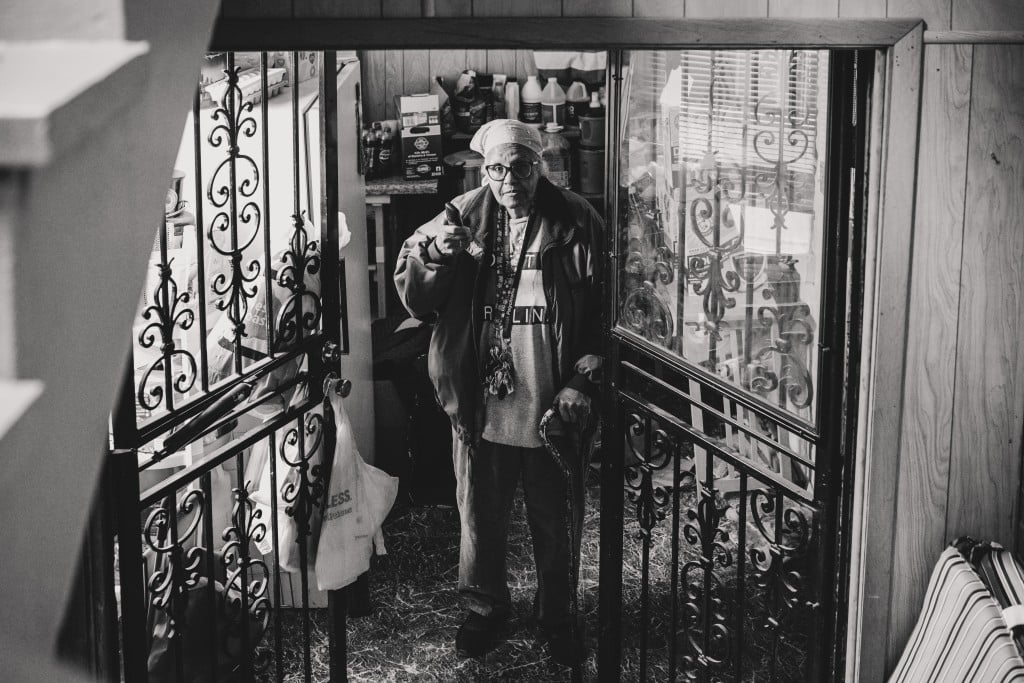
Jackson was vigilant about keeping her basements dry. Nearly 20 years ago, she installed flood control systems in the front yard of each of her properties. But on July 2, 2023, after the Westside got up to eight inches of rain, water flooded both her basements anyway.
Now, nearly a year after the flash flood, the basement of Jackson’s rental property still sits empty and the basement of her primary residence, where her grandson lives, has mold.
She’s used the roughly $13,000 she received from the Federal Emergency Management Agency (FEMA) to replace appliances that were destroyed in the flood, including a hot water tank and a furnace. She paid $37,000 for a contractor to rip out the molded walls in the rental building, among other work. But she estimates that she’ll need another $25,000 to $30,000 to completely renovate both basements.
Frustrating her best efforts
Queen, 83, contemplates the white precinct captain’s prophecy while looking out of her rental unit’s basement window at the flood control system she installed decades ago, to no avail.
From her vantage point, we have not achieved our country. The country — along with the city and the state — have let her down. The very forces of racism, prejudice and predatory capitalism are as palpable today as they were six decades ago when Baldwin warned about them and are threatening to overwhelm Queen’s vigilance and best efforts.
To file her insurance claims, Queen needed an appraisal, but contractors wanted to charge hundreds of dollars for each estimate. One contractor who charged her $450 “told me if he didn’t get the job, he wouldn’t do [the appraisal]. I told him, I don’t know if I’ll get any money or not! Just goes to show you how they’re out there trying to rip people off.”
And in the months after the water receded, Queen discovered the roof of her primary residence was damaged, water leaking through the ceiling tiles. She filed a claim for the roof with State Farm, her homeowner’s insurance provider, but was denied.
“Let me tell you what happened,” she says. “I filed an appeal for the roof. I told FEMA the insurance wouldn’t cover it. So FEMA called the insurance. Now, my insurance is canceling me because I had already filed a claim [for something] in 2007 and they didn’t pay me nothing. […] They didn’t pay me nothing but they’re canceling me! I think that’s very low down what they’re doing to people. As much insurance as we pay! I think it’s modern-day redlining.”
We don’t know the precise details of her policy cancellation (which Queen is also appealing with the help of community organizer Princess Shaw), but her suspicion of redlining, the practice of denying insurance and loans to people based on the racial makeup of where they live, is rooted in both historical memory and hard evidence.
“Back then, most of the buildings [on the Westside] had two apartments on the second floor,” Queen recalls of days living in West Garfield Park in the 1960s. “They made us Blacks make them into one apartment, but the white folk had two. They made us take [the second apartment] out. It just goes to show you how they design stuff for the white folk to make money, but not the Blacks.”
Contrast Queen’s experience with that of Linda Gartz, a white woman whose family lived in West Garfield Park in the 1960s. In “Redlined,” her 2018 memoir, Gartz writes about her family’s move to a two-flat at 4222 W. Washington Blvd.
“A single family occupied the first floor,” she writes. “On the second floor, a seventy-year-old woman held the lease and rented out two of the four bedrooms. Subletting was against building code, but for many it was an easy way to make ends meet. If Chicago building department inspectors snooped around, a show of cash usually made them go away.”
Blacks harassed by code inspectors didn’t have recourse to that kind of petty corruption. In the 1960s, many new Black homeowners were actually leasing their houses from predatory real estate agents who would arbitrarily add extra fees to already overpriced monthly payments. Blacks were also frequently harassed by housing code inspectors who would order them to make costly changes that only added to the white landlords’ fees while pushing Blacks closer to eviction.
And as more and more Black families replaced white families in areas like West Garfield Park, the more risky and uncreditworthy the area was deemed by private realtors and the federal government. It was a vicious cycle that is still spinning.

‘It’s not visible, but it’s just as deadly’
In 2022, a group of Black homeowners who hold home insurance policies with State Farm filed a federal class action lawsuit against the company. They accused State Farm of “violating the 1968 Fair Housing Act by forcing Black policyholders to wait longer than their white counterparts for their claims to be approved,” the Courthouse News Service reported.
The lawsuit “further alleges, using data drawn from 800 white and Black homeowners across the Midwest, that Black customers were 39% more likely than white customers to be asked to submit additional paperwork after filing a claim, and 20% more likely to need more than three meetings with State Farm employees in order to settle one. The additional hurdles Black customers have to clear in turn causes them to wait longer for necessary home repairs.”
On the wall of a storage room adjacent to Queen’s kitchen hangs a portrait of Martin Luther King Jr., who in 1966 moved into a rundown apartment in North Lawndale to bring awareness to the economic and racial injustices ravaging Chicago, particulary the Westside.
King thought he could use the nonviolent strategies that worked in the South to win major legal victories in the North. But Chicago organizers like Saul Alinksy had doubts about King’s approach.
“In the North you need a more sophisticated approach,” Alinsky told a magazine reporter at the time. “The segregated practices in the South are a kind of public butchery. It’s visible. There’s bleeding all over the place. Up here we use a stiletto, it’s internal bleeding, it’s not visible, but it’s just as deadly.”
Alinsky might well have replaced the stiletto with paperwork — perhaps the State Farm cancellation notice Queen received from earlier this year — as an appropriate metaphor to describe systemic racism’s lethal stealth in cities like Chicago. He could also have used mold.
“There’s mold right next to the refrigerator and behind the couch and underneath the cabinets over there,” Aaron Barnes, Queen’s 22-year-old grandson, says during a tour of his basement apartment.
Meanwhile, as the mold grows and local, state and federal governments stall, Queen fields regular calls from eager investors asking if she wants to sell her home. After all, West Garfield Park is a buyer’s market at the moment.
“They call every day,” she says. “Every day. They’re trying to get back in here. They know what’s happening.”
Related Articles
Athena Williams’ Dream of Bringing Downtown Living to Austin is Nearly Complete
The 78-unit mixed-income apartment complex will start accepting applications in June

Supreme Court’s Latest Voting Rights Decision Continues Long Rollback of Civil Rights Era Protections
Rep. Danny K. Davis says the recent Louisiana v. Callais decision ‘further erodes critical safeguards that protect voters’
West Siders Learn Tools and Techniques of Preserving Their Own Stories
At a May 9 workshop at Legler, residents explored how oral history can preserve firsthand accounts often missing from mainstream narratives about Black life