
Putting the 7th Congressional District Race Into Historical Context
Today’s political climate is more similar to the uncertain and dangerous pre-Civil War 1840s and ‘50s than the 1990s
For the first time in about 30 years, the 7th Congressional District will elect a new representative. That alone is monumental, but when you consider the extent of the country’s political fracturing and just how hollowed out the U.S. party system has become, the historic importance of the March 17 Democratic Primary becomes that much more heightened.
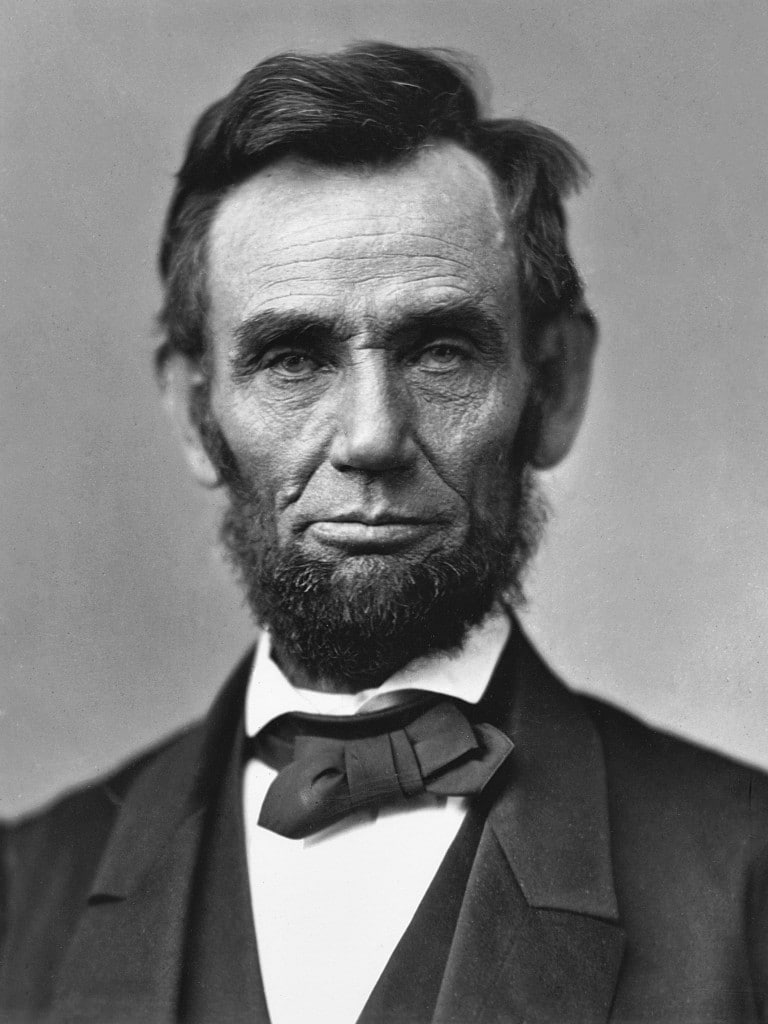
The district’s outsized influence in national politics extends at least as far back as 1846, when 7th District voters elected a relatively unknown attorney named Abraham Lincoln who ran as a Whig (a now-defunct political party popular from the 1830s to the 1850s). Of course, the district looked much different then, and politics operated through stronger party machines and civic institutions than it does today.
There were, however, some striking similarities. Then, as now, the country was mired in a war with a power-hungry president. Lincoln was a vocal opponent of the Mexican-American War, which started the year of his election. He rightly saw it as an unconstitutional war of aggression prompted, in part, by President James K. Polk’s desire to acquire more territory for slavery.
In less than a decade, Lincoln would abandon the Whig Party for the Republican Party, created in 1856 primarily to oppose the rapid expansion of slavery and promote “free labor” (in practice, this mostly applied to white men).
In 1860, Lincoln would accept the new party’s nomination for president during the Republican National Convention held at the “Wigwam,” a temporary structure built at Lake and Market streets near what is now Wacker Drive (ironically, a spot that is within the currently configured 7th District).
About a month after Lincoln won the presidency, South Carolina seceded from the Union, the first state to do so, and by April 1861, the country was in a hot Civil War.
A half-century of progressive politics
It would take three Constitutional amendments (the 13th, 14th, and 15th), multiple civil rights bills (namely the Civil Rights Acts of 1866 and 1964, and the Voting Rights Act of 1965), and decades of grassroots political struggle before the 7th District had its first Black representative.
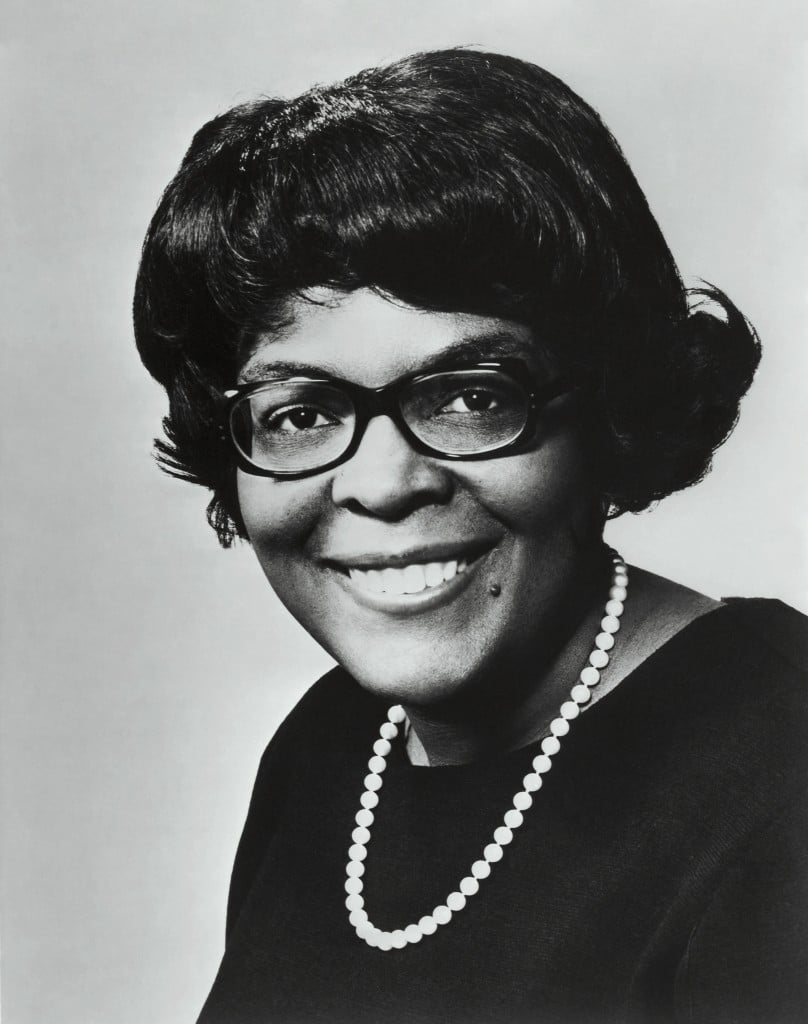
Cardiss Hortense Collins was the fourth Black woman in Congress and the first from Illinois and the Midwest, when she was elected in a 1973 special election to replace her husband, George, who was killed in a plane crash a month after winning his second term.
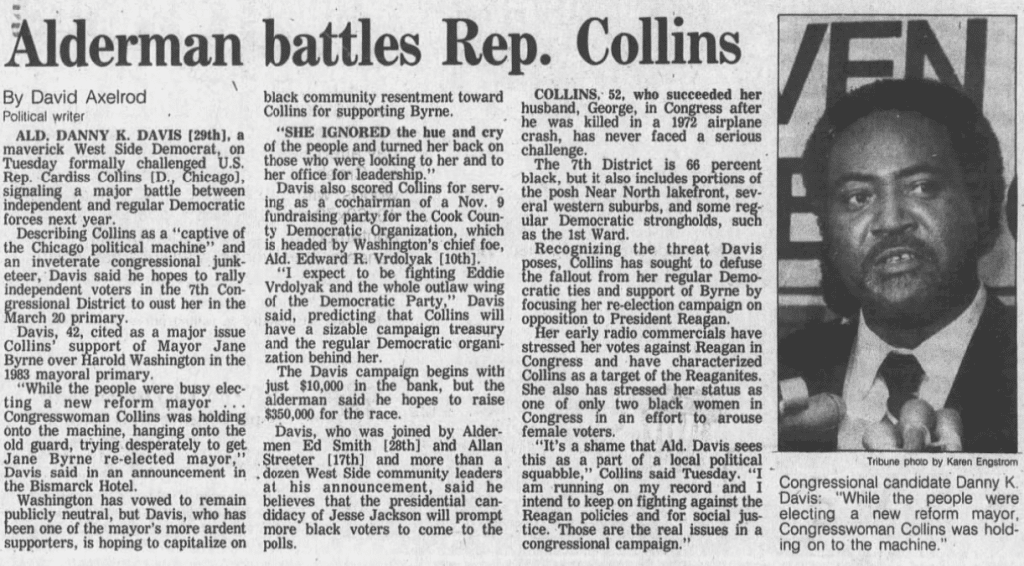
While in Congress, Collins fought for universal health insurance, gender equity, and women’s rights. But by the time Davis began challenging Collins in the early 1980s, he framed her as aligned with the remnants of the old white machine wing of the city’s Democratic Party—at a moment when Harold Washington’s insurgent mayoral coalition had changed what “reform” meant in Chicago politics.
Davis, the son of sharecroppers, embraced a politics that was against corruption and against machine discipline. Elected 29th Ward alderman as a reformer, he carried that posture into two unsuccessful congressional runs against Collins, portraying the contest as a fight over whether the West Side would be represented by an independent coalition builder or by a member anchored to the party apparatus.
That outsider energy later shaped Davis’ own rise to Congress in the mid-1990s after Collins retired, when he ran not only as a Democrat but with the support of a mix of labor and progressive groups—including the AFL–CIO, the Sierra Club, the Teamsters, and Chicago Democratic Socialists.
From mass politics to “hyperpolitics”
In the 1800s, for all the brutality of the era, national politics operated as mass politics: parties were stronger civic institutions; participation was routinized through organizations, newspapers, and clubs; and conflict—however vicious—ran through recognizable channels. The United States today often feels like the opposite, an era of omnipresent political stimulation by way of X, Facebook, Instagram, TikTok, Bluesky and similar social media platforms, paired with weak, distrusted institutions and thin party capacity.
Political theorist Anton Jäger has argued that modern politics is defined by “hyperpolitics”—a high-intensity, short-horizon environment in which politicians wonder whether they can launch their campaigns in a matter of weeks, while citizens and digital influencers cycle through demonstrations, petitions, and protests with the speed and logic of social media algorithms rather than political parties. All while nothing substantive happens to solve the systemic problems people (or, in many cases, bots) are outraged about online.
That frame matters for the 7th District because the race is not only about “who is the progressive,” but about what kind of progressive politics can actually govern, especially when the national environment increasingly resembles, in tone and stakes, the volatile pre-Civil War decades more than the relatively stable 1990s-era Congress Rep. Davis entered.
In the 1850s, Northern states responded to the Fugitive Slave Act with “personal liberty laws” designed to blunt federal enforcement. Today, Illinois has enacted sanctuary policies limiting local cooperation with federal immigration authorities. In both eras, the conflict is not only moral but constitutional, centered on who controls the streets. The federal government or the states?
In the 1850s, one of the country’s two main political parties fell apart because it could not hold together people who sharply disagreed over slavery and the future of the nation. A new party rose in its place at a time when many Americans had lost faith in their leaders and institutions. Tensions ran so high that a member of Congress was beaten nearly to death on the House floor, states openly defied federal law, and voters had to ask whether the political system itself could survive the crisis. Today, amid a war with Iran, states are fighting with the federal government over immigration and voting rules, members of Congress face investigations tied to their official duties, and both major parties are struggling to hold together coalitions that no longer fully trust one another or the system itself.
The parallels are not exact. The moral stakes and historical contexts differ. But in a district that once sent Abraham Lincoln to Congress about a decade before a national rupture and later produced its own insurgent reformers, the lessons of political realignment, institutional strain, and coalition-building are difficult to ignore. Anyone seeking to represent the 7th District at this moment would be wise to take them seriously.
Related Articles

OPINION: Eight Schools. One Purpose. Elevating the 8th District.
Shantel Franklin, a candidate for 8th District state representative, on her journey from homelessness to the campaign trail
A Forum for the Absurd: Democracy in the 7th District, 2026
A candidates’ forum in North Lawndale became an accidental portrait of American democracy in 2026: earnest, fragmented, and drifting into political absurdity
A Tale of Two Museums
The Haitian American Museum of Chicago marked its 13th birthday by hosting a fundraiser at the Ukrainian National Museum of Chicago and the experience was eye-opening