
Organizers of Austin Pop-Up Museum Reflect on the West Side Roots of Jesse Jackson’s Rainbow Coalition
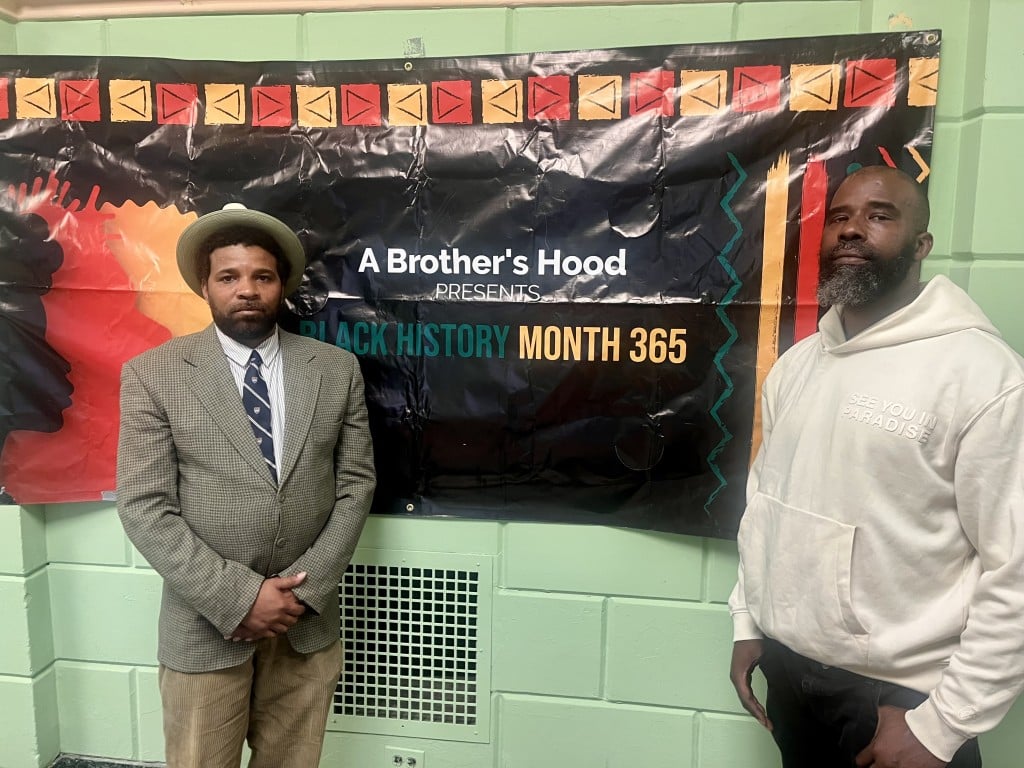
A Brother’s Hood, a cultural education group for young people, has organized a temporary museum open Saturdays through March 7
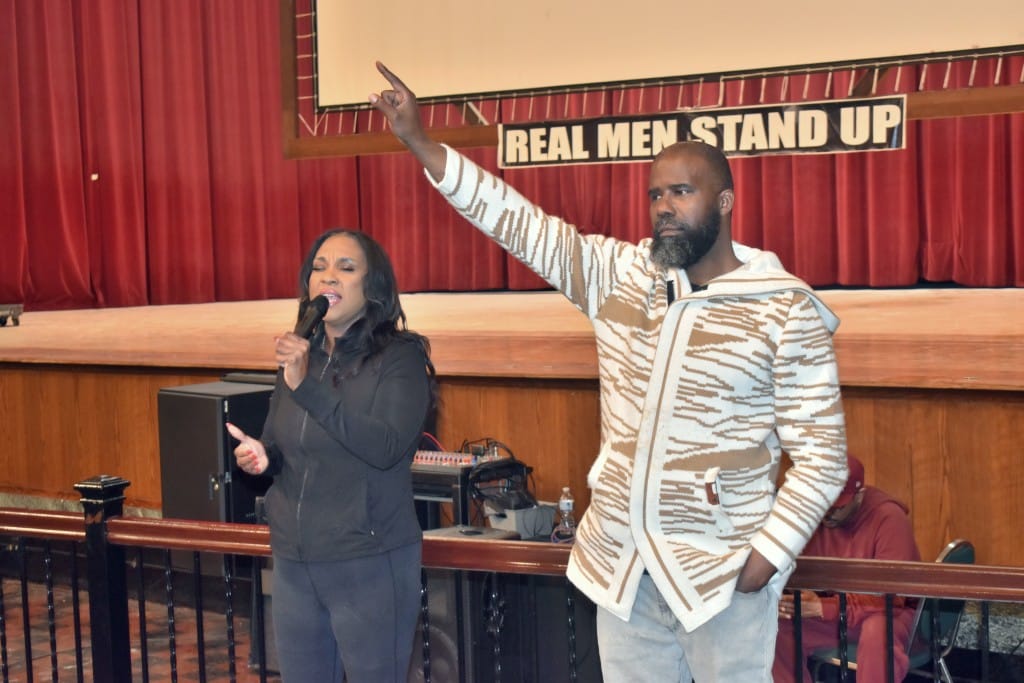
On a recent Saturday afternoon inside the gymnasium at Austin College and Career Academy, a panel draped in red, black, and green served as a background for photos of great personalities in Black History, but one photo carried added weight: an image of Jesse Jackson on the Aug. 22, 1983, cover of TIME magazine.
The interactive pop-up museum — open Saturdays from noon to 4 p.m. through March 7 at the high school, 231 N. Pine Ave. — is the second annual Black history exhibition organized by A Brother’s Hood, a West Side youth development group founded in 2024.
The recent death of the Rev. Jesse L. Jackson Sr. prompted organizers to reflect on the civil rights leader’s legacy, particularly his adoption of the Rainbow Coalition, a multiracial political alliance first forged in Chicago by slain Black Panther leader Fred Hampton.
“The rainbow coalition really comes out of Fred Hampton,” said Ieliot Jackson, a co-founder of A Brothers’ Hood. “Fred Hampton Sr. was one of the only individuals in Chicago who could bring Black and Brown people together. That’s why Rev. Jackson, after Fred’s assassination, was able to continue that work on the West Side.”
Hampton, a native of west suburban Maywood and a graduate of Proviso East High School, built alliances in the late 1960s among the Black Panthers, the Young Lords, and the Young Patriots, among other groups, in what became known as the original Rainbow Coalition. Hampton’s work was based on the West Side, and he was assassinated inside his West Side apartment at 2337 W. Monroe St.
According to journalist Abby Phillip in her biography of Jackson, “A Dream Deferred,” Hampton made appearances at Jackson’s Operation Breadbasket, even when the two organizations were not always tactically aligned.
After Hampton was killed in a 1969 police raid, Jackson delivered the eulogy at his funeral at First Baptist Church in west suburban Melrose Park. Years later, Jackson would carry the Rainbow Coalition banner into his historic presidential campaigns, transforming a Chicago-based grassroots alliance into a national political movement.
At Austin High, those threads of history are woven into a tactile, community-centered experience. Large portraits of Jackson and Hampton share space with local figures, including Jacquelyn Reed, a West Side community leader who founded the nonprofit Westside Health Authority and pastors Every Block a Village Church in Austin.
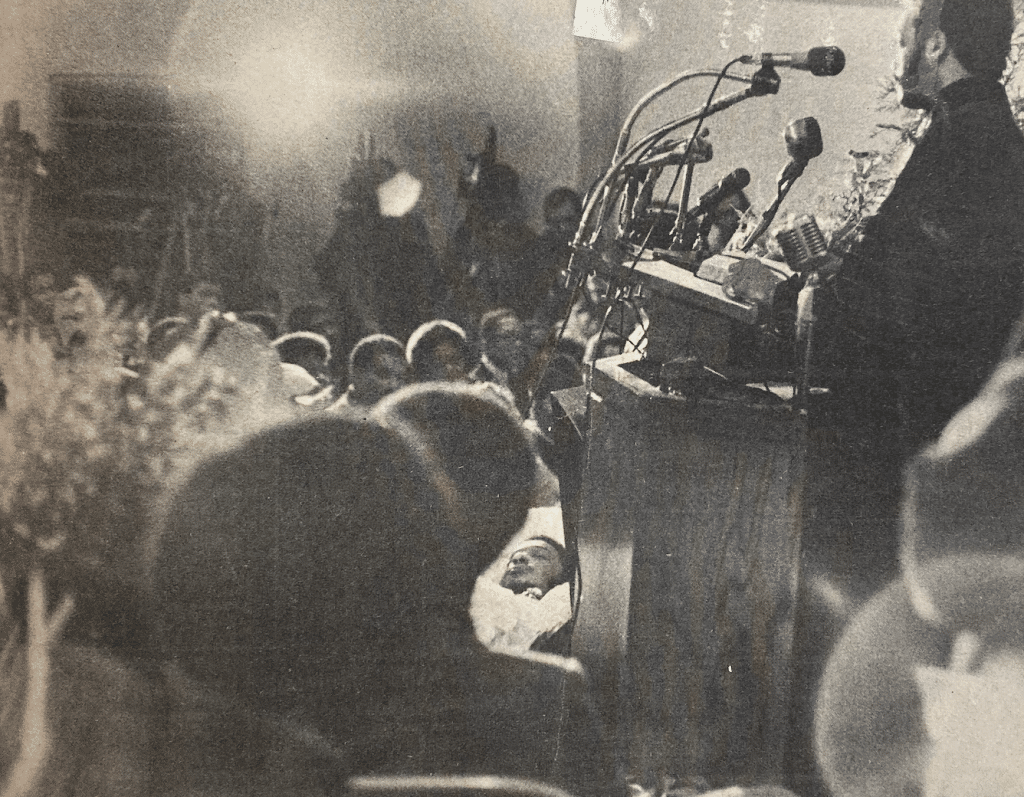
“Our mentor and spiritual adviser, Jacquelyn Reed, gave us the space to culturally enrich the community,” said Jackson, who was wrongfully convicted and later granted a certificate of innocence after serving years in prison. “We believe cultural enrichment is as important and should be sponsored as any other program, just like violence prevention. There’s big money in Black death, but where is the money in the cultural education of our kids?”
A Brother’s Hood describes its methodology as “PIESS” — an acronym for physical, intellectual, economic, spiritual, and social development. The group’s mantra, “Building Better Bonds Between Brothers,” reflects its focus on reconnecting men in the community, many of whom, organizers say, feel economically and socially disconnected.
Clabe Johnson, another co-founder, said the organization grew out of mutual aid efforts following the 2023 flooding that damaged homes across Austin.
“As we were mucking out homes, we saw a lot of men felt disconnected,” Johnson said. “They didn’t feel like they had a vested interest. A lot of men are unemployed, couch-surfing. No matter where you’re at, we’re seeking to build a bond there and develop that.”
The group’s first event was a Halloween haunted house at Westside Health Authority that drew dozens of children. A subsequent Halloween festival drew about 500 participants. The Black history exhibition expanded that momentum into a structured cultural program.
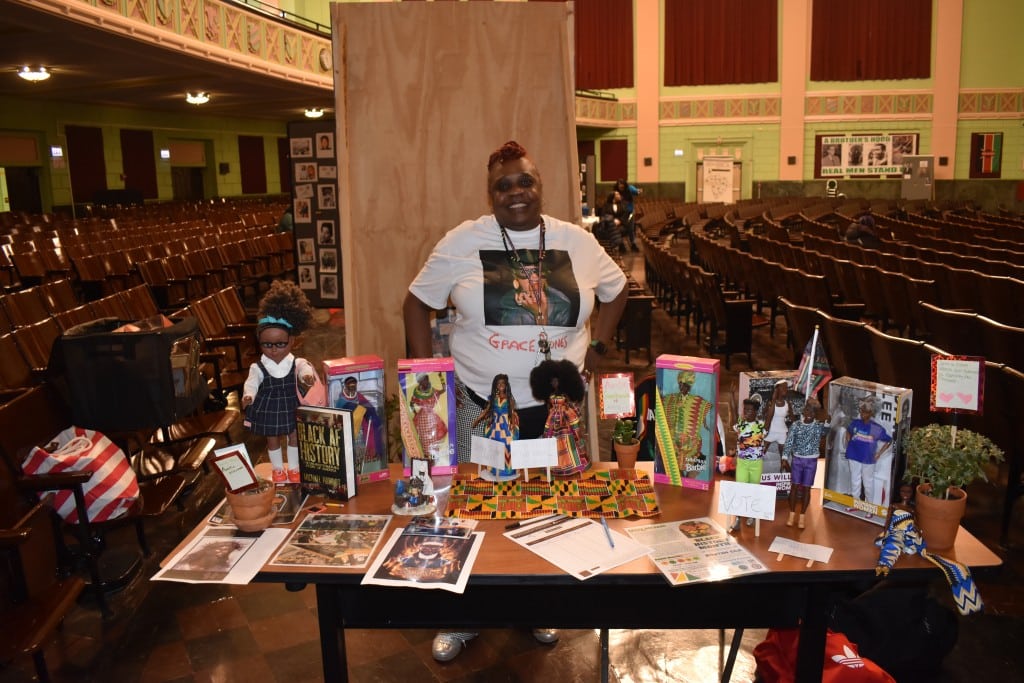
Simone Jones, 55, an Austin resident exhibiting her collection of multicultural dolls and Black history collectibles, said Jackson’s death felt personal.
“I was struck when I heard he died,” Jones said. “Even though I didn’t know him, I felt like I did. I met him one time when I was a little kid with my mother. That experience stayed with me.”
For organizers, the exhibit is as much about lineage as memory. They recalled attending last year’s commemoration of the 55th anniversary of Hampton’s assassination at the DuSable Black History Museum and Education Center, where they learned that cultural funding is often limited to established institutions.
“We saw that the only institutions using available cultural funding were museums and libraries,” Jackson said. “But that same funding is available to individuals and institutions in the community that highlight cultural enrichment. So we have to build that space in the community to continue.”
That space now fills the gym at Austin High, where students can scan QR codes beneath historical images, engage with elders, and encounter a living timeline that connects Hampton’s 1960s coalition-building to Jackson’s presidential runs — and to present-day efforts to unify neighborhoods still grappling with economic inequality and racial tension.
“We never want to forget the legacy makers,” Jackson said. “That’s the connection — from Fred Hampton to Rev. Jesse Jackson to the West Side today. The more we give, the more it’s received.”
Related Articles
Candidate Forums for CPS Local School Council Elections Begin Next Week
With forums running Feb. 23–27, fewer than half of West Side LSC races currently have enough candidates
West Side Clergy Remember Life and Legacy of Jesse Jackson, Push for Voting Bill Named After Him
During a Feb. 21, local pastors and leaders recalled Jackson’s ‘Keep Hope Alive’ mantra, while Speaker Welch vowed to pass the Jesse L. Jackson Sr. Young Voters Empowerment Act
Rev. Jesse Jackson, Civil Rights Strategist and Architect of Modern Democratic Coalitions, Dies at 84
The Baptist minister and activist also influenced clergy, activists, and politicians on the West Side and in the west suburbs