How the Greater West Side Voted in the Last Primary Election
Turnout lagged below 21% across the West Side and Proviso Township in 2024
In the last major primary election on March 19, 2024 — which included presidential nominating contests along with a range of federal, state, and county offices — turnout remained below 21% in the four West Side wards and several west suburbs in the Proviso Township area that constitute The Culture’s readership footprint.
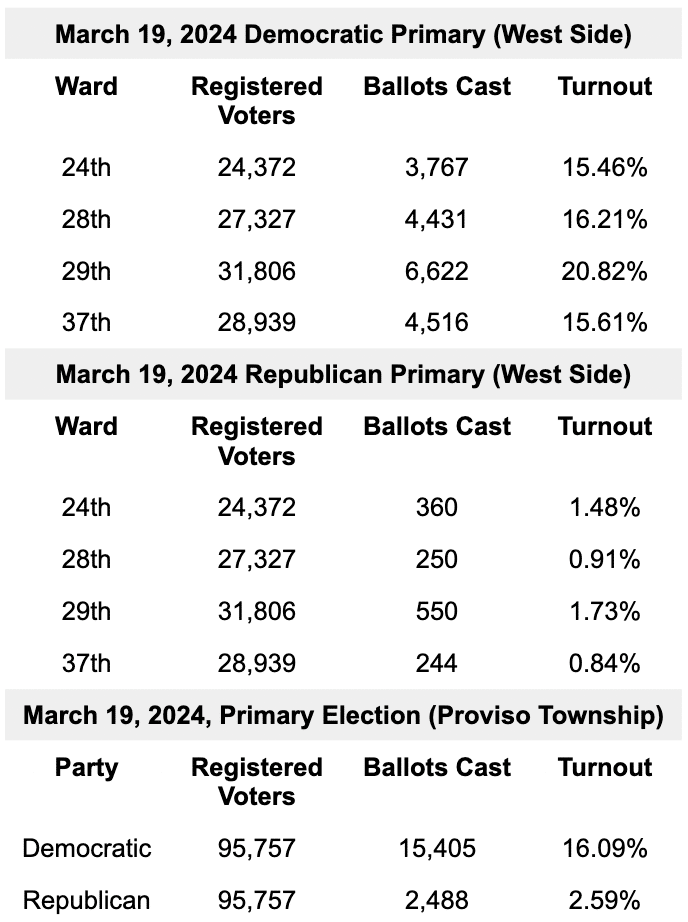
Data from the Chicago Board of Elections and the Cook County Clerk’s Office show that Democratic primary participation ranged from 15.46% to 20.82% in the 24th, 28th, 29th, and 37th wards.
The 29th Ward posted the highest Democratic turnout among the four, with 6,622 ballots cast out of 31,806 registered voters, or 20.82%. In the 28th Ward, 4,431 of 27,327 registered voters cast Democratic ballots, a turnout rate of 16.21%.
The 37th Ward recorded 4,516 ballots cast out of 28,939 registered voters, or 15.61%, while the 24th Ward saw the lowest Democratic turnout of the four, with 3,767 ballots cast out of 24,372 registered voters, or 15.46%.
Republican primary participation in those same wards was significantly lower.
In the 29th Ward, 550 Republican ballots were cast, representing 1.73% turnout. The 24th Ward recorded 360 Republican ballots cast, or 1.48%. The 28th Ward saw 250 ballots cast, or 0.91%, and the 37th Ward had 244 ballots cast, or 0.84%.
Although the March 2024 ballot included presidential primaries — contests that often help drive participation — turnout in these heavily Democratic areas remained concentrated in one party’s primary and hovered well below a quarter of registered voters overall.
In west suburban Proviso Township, which includes communities such as Maywood, Bellwood, and Broadview, participation followed a similar pattern.
Of 95,757 registered voters townshipwide, 15,405 cast Democratic primary ballots, for a turnout rate of 16.09%. Republican participation reached 2.59%, with 2,488 ballots cast.
The numbers illustrate how even during a presidential primary year — when the top of the ticket is on the ballot — participation in parts of Chicago’s West Side and neighboring west suburbs remained relatively low compared with registration totals.
In districts where the Democratic nominee is widely expected to prevail in November, the primary often functions as the decisive election. That dynamic means fewer than one in five registered voters in some wards effectively shaped which candidates advanced to the general election ballot.
Looking ahead, turnout patterns could shift in 2026. According to reporting by ABC 7 Chicago, five open congressional seats in Illinois could help drive higher participation in the March 2026 primary ahead of the midterm election. In the 7th Congressional District, 13 candidates are running to succeed Congressman Danny K. Davis.
Open seats tend to generate competitive races, increased campaign spending, and heightened voter outreach — all factors that historically boost engagement. Without incumbents on the ballot, primaries often become the central battleground, particularly in districts dominated by one party.
Whether that translates into substantially higher turnout on the West Side and in Proviso Township remains to be seen.
Related Articles
Kindred Civic Arts Forum Opens Women’s History Month With Cole Arthur Riley Conversation in Austin
Author of Black Liturgies and This Here Flesh reflects on Black interior life, spirituality, and emotional survival during a turbulent political moment
BALLOT POWER
A nonpartisan voter guide for the Greater West Side created with the help of the Westside Branch NAACP
Meet the Candidates: Their Own Words Ahead of the March 17 Primary
The Culture, in partnership with the Westside Branch of the NAACP, sent questionnaires to candidates running for key offices that will directly shape local life