Austin Business Hub Opens Doors With Trades Program Aimed at Building West Side Workforce
The Rutues Center for Business & People Development launches 16-week trades program to create pathways into union jobs, entrepreneurship, and licensure
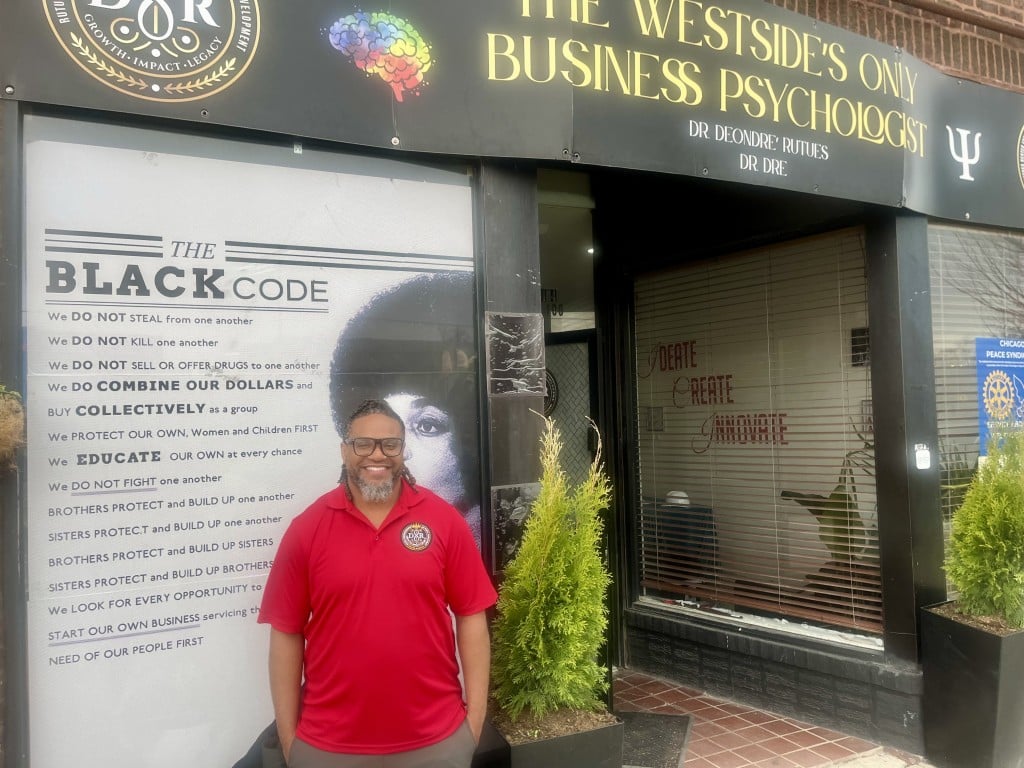
A new workforce development hub on Chicago’s West Side is betting that the path to economic stability runs through skilled trades, structured support, and a deeper investment in people.
The Rutues Center for Business & People Development, located at 5044 W. Madison St. in Austin, recently hosted an open house introducing residents to its Trade & Social Skills Lab—an apprenticeship-style program designed to prepare participants for careers in HVAC, plumbing, and electrical work while also building the soft skills needed to sustain those careers.
Founded by Deondre Rutues, a business psychologist and community leader known locally as “Dr. Dre,” the center reflects a broader vision that blends workforce training with social development.
Rutues said the idea grew out of both personal experience and professional observation.
“My vision is economic and social capital development,” Rutues said in a recent interview. “I’m from here, and one of the traits of being a business psychologist is I analyze my environment and see what’s missing.”
What he saw, particularly along the Madison Street corridor, was a lack of accessible, community-rooted pathways into stable, high-paying careers—especially for residents who may not see traditional college as their primary route.
The center’s flagship offering is a 16-week program that cycles through three core trades: HVAC from July to October, plumbing from November to February and electrical training from March to June. Each session includes two cohorts of five participants, meeting Tuesdays, Thursdays and Sundays, with both daytime and evening options.
Beyond technical instruction, Sundays are reserved for a social development component, where participants come together to build communication, professionalism, and interpersonal skills—areas Rutues said are just as critical as technical ability.
“We’re not just teaching a trade,” he said. “We’re helping people become whole professionals.”
Participants begin with certification training and are then paired with experienced technicians for hands-on development. Upon completion, they can pursue one of three pathways: launching their own business, entering a union apprenticeship or obtaining licensure.
The program is supported through partnerships with organizations such as Hire 360, which helps connect participants to apprenticeship opportunities, and OAI Inc., which provides educational support.
At the open house, attendees had the opportunity to hear directly from industry professionals who will help guide participants through the program. Among them was Marcus Pickett, president of Temperature Doctors Heating and Cooling Inc., who emphasized both the durability and the earning potential of skilled trades.
“AI can’t do plumbing,” Pickett told attendees, underscoring the long-term stability of the field.
Pickett, who grew up in Austin and now operates a business with multiple locations, said the trades offer not only job security but also a pathway to entrepreneurship. He noted that industries like HVAC generate trillions of dollars globally and remain in high demand.
“We’re not just teaching you a trade—we’re teaching you how to run your business the right way,” he said.
The open house also highlighted the program’s accessibility, including free certifications, training from master technicians and ongoing local support. Organizers framed the initiative as a direct response to economic barriers that have historically limited access to these industries for West Side residents.
Rutues’ approach is shaped by his background in industrial-organizational psychology and his work across corporate, public and nonprofit sectors, including roles with major companies and local institutions. His model integrates what he describes as “psychological capital”—a focus on confidence, resilience and mindset—into workforce development.
That philosophy extends beyond the trades program itself. The Rutues Center also functions as a shared workspace, welcoming entrepreneurs, clinicians, content creators, and other professionals seeking a collaborative environment.
Rutues said he intentionally chose to invest in the Austin community, even as the decision came with personal and financial challenges.
“It wasn’t an easy move,” he said. “But I felt like this was where I was supposed to be.”
He envisions the center as a modern version of a historically vibrant community ecosystem—one where professionals from different fields operate side by side, creating both economic opportunity and social cohesion.
“There used to be a point when the doctors were next to the lawyers next to the bakers,” he said. “I get to be that for the community.”
In addition to workforce training, Rutues hosts weekly “Courageous Conversations” through the West Side Heroin Opioid Task Force, providing a space for Black men navigating addiction and recovery to discuss trauma and healing.
For Rutues, these initiatives are interconnected.
“Socially, we don’t connect as widely as we can,” he said.
The Trade & Social Skills Lab, he added, is as much about rebuilding those connections as it is about job training.
As the center continues to recruit participants and expand its programming, Rutues said his goal is to create a sustainable model that can be replicated across other communities.
“I want to transform the environment, the people, and the practices,” he said.
For more information on the trades program, call (773) 543-5968 or visit deondrerutues.com
Related Articles
Chicago Black Restaurant Week Runs Feb. 8-22
One Austin restaurant and four west suburban restaurants will participate this year
This Bellwood Restaurant Could Be the Best Place to Watch the Super Bowl in the West Suburbs
Elements Restaurant brings a cinematic sports setup and fine dining to the viewing experience