A Tale of Two Museums
The Haitian American Museum of Chicago marked its 13th birthday by hosting a fundraiser at the Ukrainian National Museum of Chicago and the experience was eye-opening
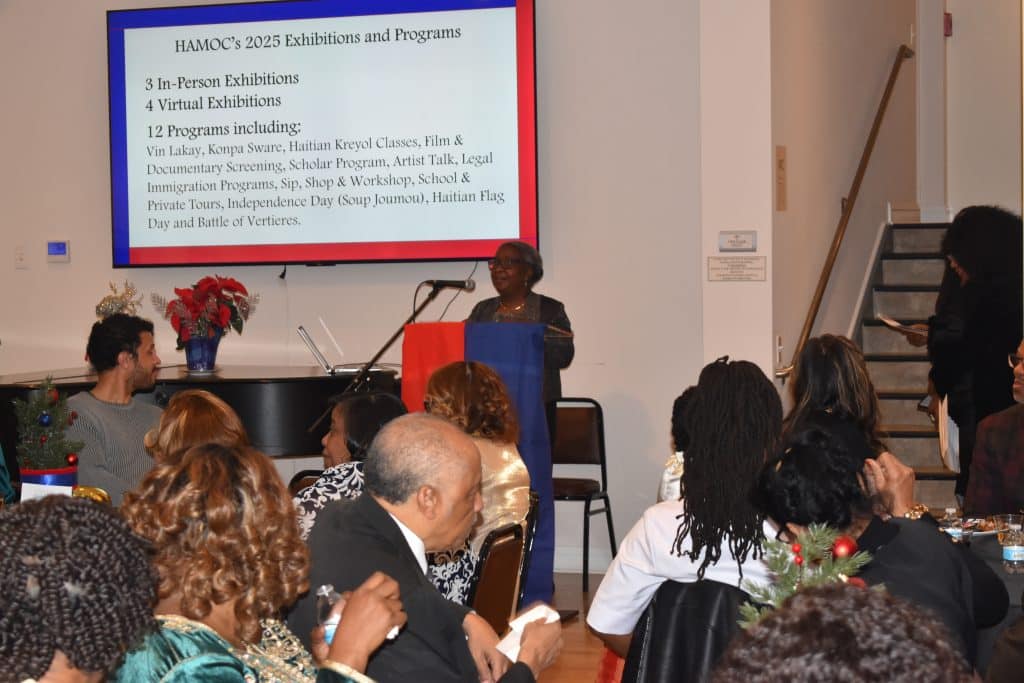
On Saturday, I found myself standing in the Ukrainian National Museum of Chicago in Ukrainian Village, where the Haitian American Museum of Chicago (HAMOC) held a fundraiser. It was a fitting, if unexpected, pairing. As I walked past photos of Ukrainian resistance fighters and artifacts of centuries-old struggles for independence, I felt the undeniable connection between Haiti and Ukraine—two nations that have wrestled mightily against empires and refused to surrender their sovereignty or cultural identities.
Haiti, the world’s first Black republic, emerged from an 18th-century uprising that dismantled the brutal machinery of French slavery. That revolution changed the trajectory not only of Haiti but of the Western Hemisphere. Ukraine, for its part, has spent much of its modern history resisting imperial domination—first from czarist Russia, then the Soviet Union, and now Russian aggression. Ukrainians and Haitians alike live with the memory of occupation, the assertion of dignity, and the insistence on self-governance.
For Elsie Hector Hernandez, the founder and CEO of HAMOC, the connection was much more than symbolic. Her relationship with the Ukrainian museum was built through the generosity of Jaroslaw “Jerry” Hankewych, the Ukrainian National Museum’s late executive director, who died of COVID in 2020.
“Why the Ukrainian Museum? Why Haiti and Ukraine?” Hernandez told guests at the fundraiser. “At the end of 2013, I was working at Norwegian Hospital in Humboldt Park, and I was walking on Western Avenue. I went into an accounting firm and said, ‘I have a museum, and I don’t know how to do the accounting part of it.’ Jerry, the president of the Ukrainian museum at the time, told me he would help me.”
Hernandez said their relationship never felt transactional, deepening into friendship and institutional solidarity.
“We would have lunch together. I would stop by his office. He did my 2013, 2014, 2015 accounting for free,” she said. “Not only that, Jerry became such a friend that he suggested HAMOC join the Chicago Cultural Alliance. We were among the few ethnic museums that were members of the Alliance. So I have a personal connection with the Ukrainian museum.”
As Hernandez spoke, I kept thinking about the importance of ethnic museums to sustaining cultural identity. What kind of world would we be without them?
Nowadays, Hernandez is working to build something even stronger. HAMOC is transitioning from its Ravenswood home at 4410 N. Clark St. to a new location at 4623 N. Clark St. in Uptown, expanding its ability to tell the history of Haitians in Chicago—a history too few Chicagoans know.
“Just being around the history inspires me,” Ariel O’Neal, 30, a member of HAMOC’s advisory board, told me during Saturday’s fundraiser. “It’s important to know that Chicago was founded by a Haitian man. The city’s a melting pot. We should learn how it originated.”
You can support HAMOC by donating at its website, hamoc.org. Proceeds will go toward programming and capital expenses for its new location, which is slated to open in a few months. HAMOC’s new book, “Haitians in Chicago (Images of America),” will be published on Dec. 30. You can pre-order the book by emailing info@hamoc.org or calling (773) 213-1869.
And while you’re at it, consider supporting the Ukrainian National Museum, which continues preserving its community’s story even after the loss of Hankewych. Visit the museum’s website at ukrainiannationalmuseum.org.
What This Is
The Quiet Before is a column about attention, thought, and the demystification of history and everyday life — and about the slow, communal work of reading and writing, the necessary and sufficient conditions for meaningful social change. It lingers in the spaces where reflection still matters — where taking time to think is its own quiet form of resistance.
Related Articles

OPINION: Halt the Current CPS CEO Selection Process and Install Dr. Macquline King as CEO Through the School Year
“This is not a casual disagreement over preference or personality”
OPINION: Eight Schools. One Purpose. Elevating the 8th District.
Shantel Franklin, a candidate for 8th District state representative, on her journey from homelessness to the campaign trail
Putting the 7th Congressional District Race Into Historical Context
Today’s political climate is more similar to the uncertain and dangerous pre-Civil War 1840s and ‘50s than the 1990s