
A Chef’s Kiss for the West Side
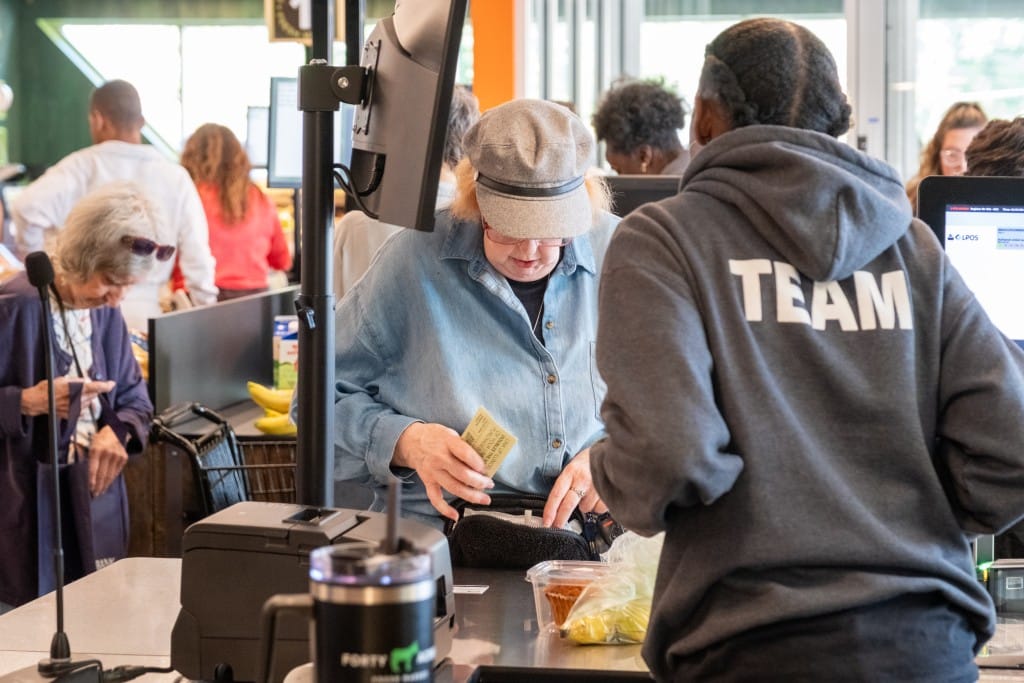
Austin’s Forty Acres Fresh Market raises the bar on neighborhood grocery stores. At a Sept. 27 grand opening for the store and its neighboring PNC Bank branch, owner Liz Abunaw broke down the how and why
Nearly a decade ago, Liz Abunaw stepped off the No. 66 bus at Chicago and Laramie looking for cash. She didn’t want to pay $5 in ATM fees to withdraw $20, but in Austin, she couldn’t find a bank or even a grocery store where she could get cash back with a purchase.
“I don’t believe in paying more for my money in Austin than I would if I were in the South Loop or Lincoln Park,” Abunaw said.
That experience planted the seed for what would eventually become Forty Acres Fresh Market, the full-service, brick-and-mortar grocery store at 5713 W. Chicago Ave., which evolved from Abunaw’s produce delivery business started in 2017.
The store and its neighbor, a new PNC Bank branch (the bank’s first brick-and-mortar in Chicago in seven years), held official grand openings on Sept. 27, helping to address the gaping inequity that set her journey in motion and giving Austin what Abunaw believes is arguably the best neighborhood grocery store in the city, both from an operational and a design standpoint.
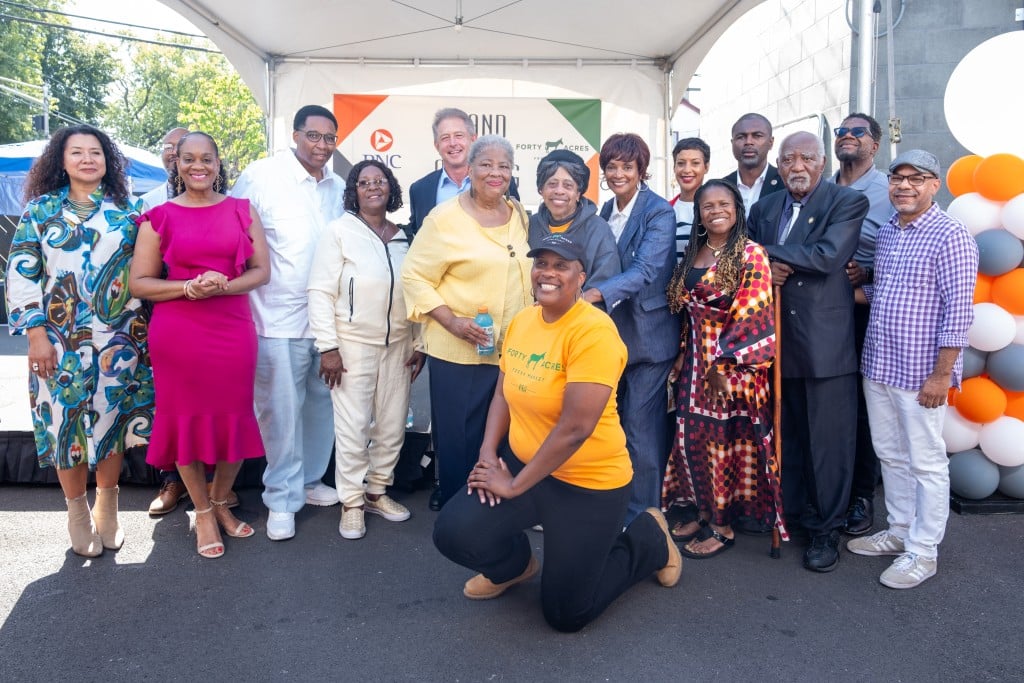
“A lot of people said the store meets a basic need, and it does. Food is a basic need,” she said. “But if you’ve been inside Forty Acres, you know this store is far from basic. This store is absolutely beautiful. Let’s be clear. Austin’s neighborhood grocery store is far nicer than what’s in any other neighborhood.”
There’s a lot at Forty Acres to back up Abunaw’s bold claim, starting with the award-winning architecture that preserves the structural elements of the former Salvation Army, like the striking wooden bowstring trusses that help turn shopping at the Austin store into an aesthetic experience.
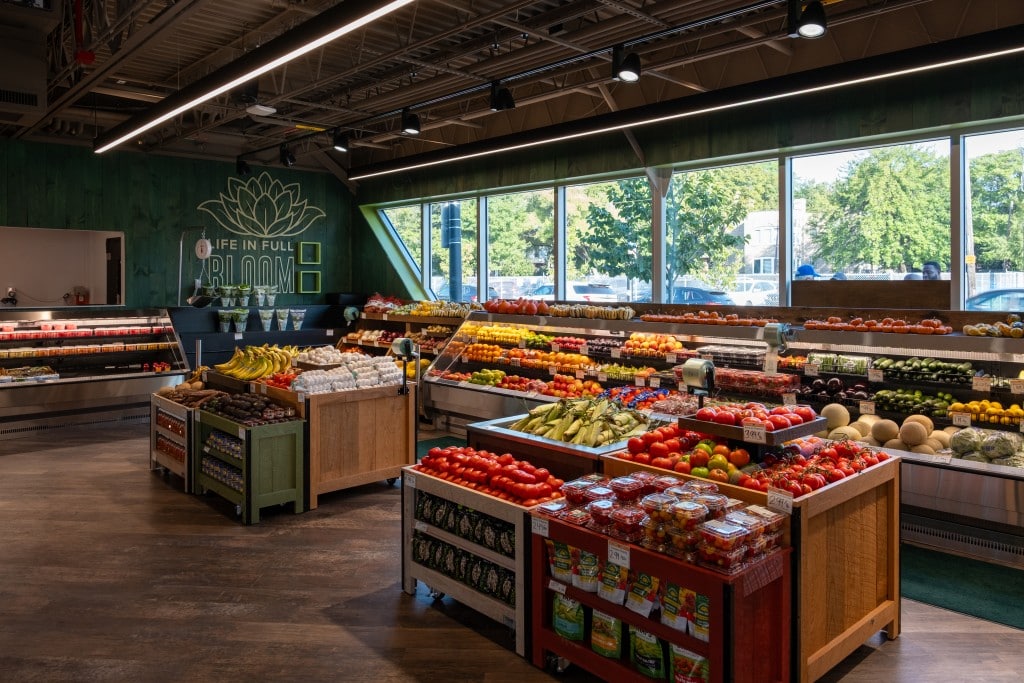
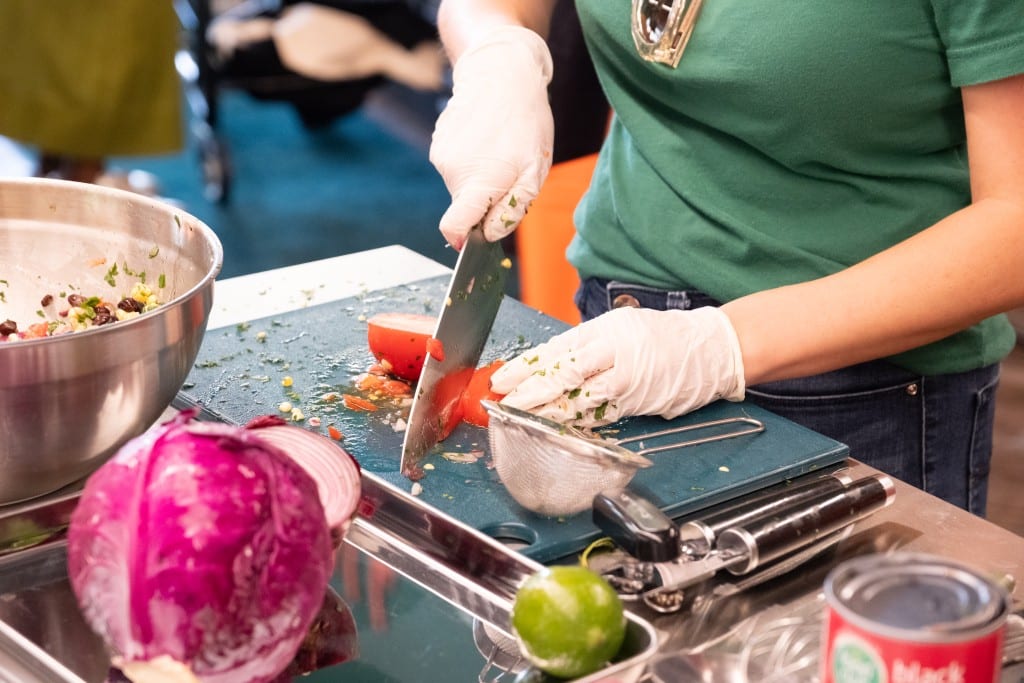
The store’s hot bar, Mabel’s Meals, serves up standouts like the Coco Bowl — coconut curry with bell peppers, onions, broccoli, and rice, topped with fried chickpeas and cilantro aioli. Good luck finding that at Pete’s or Mariano’s.
The store’s head butcher, Ilya Bonel — a protégé of acclaimed chef and butcher Rob Levitt — turned down bigger grocery chains to join Forty Acres, drawn by the better work-life balance. In the process, he brought with him rare meat-cutting expertise and a discriminating palate you’d be hard-pressed to find anywhere else.
There’s even a permanent kiosk from which Foodsmart, the largest national network of registered dietitians, will help shoppers curate healthy eating habits.
A Corridor Transformed
Standing at the podium, Abunaw reflected on how much has changed in the years since she started her business.
“This is not the same Chicago Avenue that I Columbused all the way back in the fall of 2016,” she said. “The realization of this whole city corridor has been underway for years, and that manifestation is seen in new buildings like this one, public spaces like PopCourts, new businesses like my favorite coffee shop down the street, Urban Essentials. It can be seen in the widened sidewalks, on the bike lanes, trees, and the benches my staff love to sit on when they are on break. Looking out the store windows, I regularly see joggers now coming down Chicago Avenue. I didn’t see that in 2018. This neighborhood looks different from how it did seven years ago.”
She said others are noticing the shift, too, before lamenting that the widespread appreciation doesn’t often come with an acknowledgment of the political legwork that went into the transformation.
“I’ve had numerous people say to me, ‘They’re really building that area up. I see it!’ But there seems to be a disconnect because at the same time they see the neighborhood changing around them, you will then hear people say, ‘But these politicians don’t do nothing for us, or a particular party ain’t done nothing for Black people.’ So when people tell you that these politicians don’t do anything for you, you point to this site right here.”
The Financial and Logistical Machinery Behind the Store
Abunaw emphasized that Forty Acres didn’t arrive by chance. It took coordination across multiple levels of government and years of navigation through grant programs, permits, and licensing.
- Federal support through the 2014 Farm Bill created the USDA Healthy Food Financing Initiative that funded her first market study and architectural drawings.
- State grants helped purchase refrigeration equipment to stock fresh produce.
- City of Chicago funds, like the Neighborhood Opportunity Fund and other development grants, secured with help from Rep. Camille Lilly (78th), underwrote construction.
- Local government backing included 37th Ward Ald. Chris Taliaferro’s support in converting Waller Avenue from one-way to two-way, improving access to the site.
- Continuity across administrations mattered: Lori Lightfoot’s Invest South/West initiative initiated the process, and Mayor Brandon Johnson’s administration ultimately released the funds. Deputy Mayor Kenya Merritt was singled out by Abunaw as “a one-woman force” guiding Forty Acres through permitting and licensing.
- Private and Nonprofit Partnerships: Alongside public dollars, private donors, foundations, and nonprofits played major roles—not just in funding, but in credibility, technical support, and long-term backing. Among them: Oprah Winfrey Foundation, American Heart Association, University of Chicago, Christopher Family Foundation, and Builders Foundation. These institutions often help projects qualify for grants or bridge funding gaps.
- Other private sector support included the firm Keith Wicks and Associates, which helped Forty Acres create a financial plan. Certco Inc., a food supplier based in Madison, Wis., “took a chance on an unknown store” and helped figure out assortment and pricing while also lending the young store their expertise, Abunaw said.
- Internally, the grocery store depends on at least two dozen employees, including four store managers, a market team that facilitates the Austin Town Hall Park Farmers Market, and a delivery team.
The Wizard of Oz and the Builders of Soul City’s Forty Acres Market
Abunaw likened her journey to The Wizard of Oz, casting herself as Dorothy traveling a long road with three friends who helped her realize her vision in Austin — or, as she put it, her version of the Emerald City.
“There are times when I think of myself as Dorothy and Austin as Oz,” she said. “Dorothy had a lion, and that is Malcolm Crawford … She had a tin man, and that is Darnell Shields … And when Dorothy left Oz, she told the scarecrow, ‘I’m going to miss you most of all.’ In my Oz, Morris Reed is my scarecrow.”
- Malcolm Crawford, head of the Austin African American Business Networking Association (AAABNA), was the earliest and loudest voice behind the Soul City Corridor concept. Abunaw said he “spoke Soul City into existence” through sheer persistence, creating the framework that made investments like Forty Acres possible.
- Darnell Shields, executive director of Austin Coming Together (ACT), provided crucial organizational support through ACT’s Austin Eats initiative, which backs healthy food enterprises. His coalition-building and logistical backbone gave Abunaw a base from which to scale her vision.
- Morris Reed, CEO of the Westside Health Authority (WHA), served as both visionary and institutional anchor. WHA is the landlord for the building, the steward of its redevelopment, and a partner in ensuring the project had the stability to reach completion. Reed, Abunaw said, believed in her vision, lent his team’s expertise, and gave the project legitimacy. She specifically thanked Rosie Dawson, WHA’s property manager, for Dawson’s critical role in the development process.

Architectural Vision and Design: Adaptive Reuse Meets Identity
The design of Forty Acres Fresh Market is not just about aesthetics—it’s about signaling permanence, respect for history, and functional excellence. Latent Design and other partners shaped the store to be both beautiful and rooted in its context.
Forty Acres Fresh Market and Westside Health Authority acquired the former Salvation Army building at the intersection of Waller Street and Chicago Avenue. Rather than demolishing and rebuilding, the project retains significant structural character—including restoring historical wooden bowstring trusses. This reduced some demolition and rehab costs, preserved the building’s character, and anchored the store in local history. The design has already garnered recognition, earning Metal Architecture magazine’s prestigious Metal Architecture Retrofit Award this year.
Getting the design from Latent was only part of the process. Other firms involved include Rockey Structures (structural), CCJM (mechanical-electrical/plumbing), Engage Civil (civil engineering), TGDA for landscape, StoreMasters and Retail Planit for grocery operations, and IFF as a client representative. Coordination among all those firms had to be aligned on permitting, code compliance, utility access, freight handling, and refrigeration, among other key aspects.
“You are not just a transaction. You are not just a number. You are a person, and this is your store.”
A Catalyst, Not a Cure
Despite the excitement around the store’s grand opening, Abunaw acknowledged the structural risks that come with opening an independent grocery store in Austin. Nearly 97,000 Austin residents still rely on just four grocery stores across 7.5 square miles. Often, new grocery stores in underserved communities shutter in less than two years.
“I am terrified,” she admitted. “My goal is not simply to open a grocery store; it is to sustain a thriving store for years to come. Getting one open is one thing, but keeping one open is completely different. I am haunted by the ghosts of other stores that have opened to so much fanfare in similar neighborhoods across the country, only to be forced to close 12 months, 16 months, 18 months later.”
Abunaw attributed those closures to a factor that often gets overlooked in the dominant media narrative about grocery stores in Black communities.
“It was not for the reasons that the internet says,” she said. “No, people weren’t stealing. Those stores met their fate for a reason more insidious than theft: low traffic. They could not get people through their doors. Those stories stay with me. They chase me to sleep, and they wake me up at night.”
During the Sept. 27 grand opening, Abunaw urged community members to hold her and her team accountable before recalling a story about a customer who told Forty Acres employees that the milk prices were too high. In response, they lowered the prices.
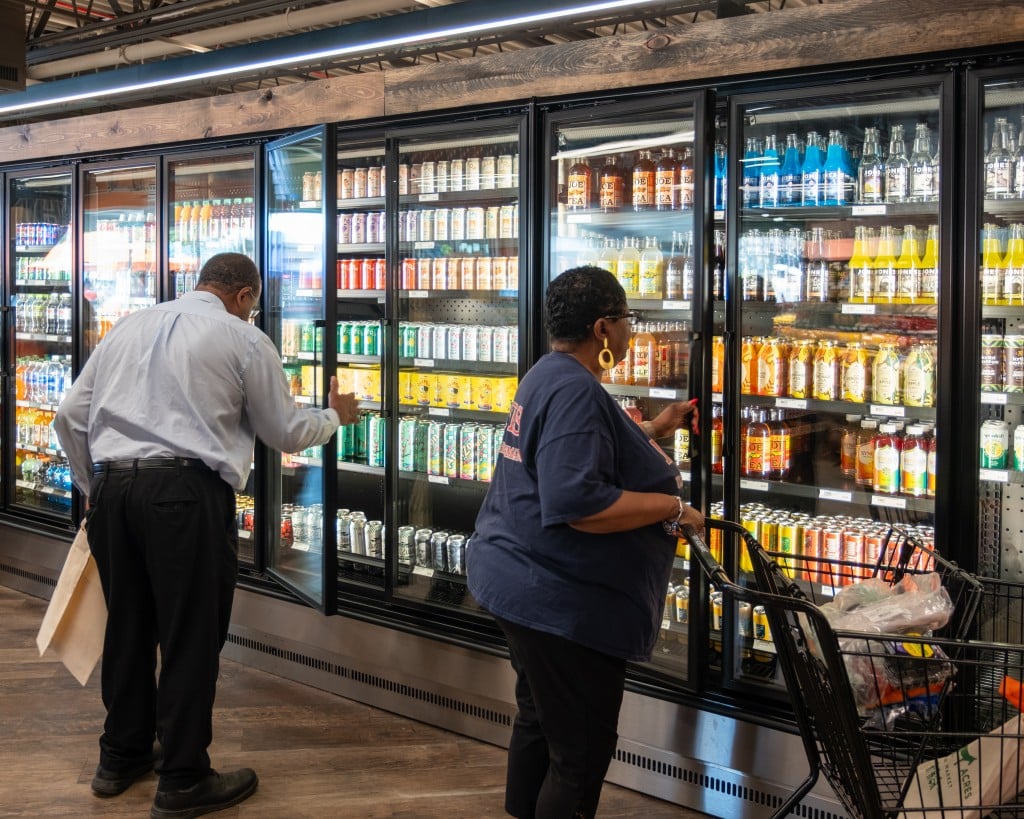
“Austin, you owe me nothing. It is my job to get you into this store. It is my job to keep you in this store,” she said. “If you come into this store and you don’t find what you need, before you walk out the door, find somebody and tell them, because you don’t know what we can do for you. This store is unlike any other. We are your neighborhood store. You are not just a transaction. You are not just a number. You are a person, and this is your store.”
Related Articles
Athena Williams’ Dream of Bringing Downtown Living to Austin is Nearly Complete
The 78-unit mixed-income apartment complex will start accepting applications in June

Supreme Court’s Latest Voting Rights Decision Continues Long Rollback of Civil Rights Era Protections
Rep. Danny K. Davis says the recent Louisiana v. Callais decision ‘further erodes critical safeguards that protect voters’

West Siders Learn Tools and Techniques of Preserving Their Own Stories
At a May 9 workshop at Legler, residents explored how oral history can preserve firsthand accounts often missing from mainstream narratives about Black life