
Nico Tsatsoulis
Tsatsoulis’s full response to a questionnaire submitted by The Culture and the Westside Branch NAACP

Full Name (as it will appear on the ballot)
Nico Tsatsoulis
Party affiliation
Libertarian
How can people learn more about your campaign?
There is an incredibly strong body of research showing how property assessment practices and the broader system can shift the tax burden toward lower-income, majority-Black neighborhoods. Do you believe Cook County’s assessment system operates with a racially disparate impact—what many researchers call an ‘assessment gap’—where Black homeowners are more likely to be over-assessed relative to market value and therefore pay a higher effective tax burden than similarly situated white homeowners? Yes or no.
The way the system is set up is to pit one constituent against the other. Politicians have created a zero-sum game and if one homeowner pays less, another one must pay more. It is by design and not by accident. Democrats have been ruling this city and county for over 70 years and what we get is higher property taxes. In real terms, property taxes are up by 48% the last 20 years. Effectively we are paying rent to the government although nominally we own our homes. There exists an “assessment gap”. Only 16% of Black households appeal their tax assessment. The number for Latino is 19%, for Asian 38% and for white 72%. Black and brown households have fewer financial means and information to go about appealing their inflated assessments. The assessments are overinflated on purpose so that owners with limited means pay more. The biggest victims are the black and brown households. It is a regressive system that by design aims to hurt the less privileged.
If yes, name the top three remedies you will implement using the Assessor’s powers in your first year, and the metrics you will publish to prove the gap is shrinking (e.g., neighborhood-level sales-ratio studies, overassessment rates, exemption uptake, and appeal outcomes by race/income).
The first step to make the assessment fair is to use market values instead of values derived by a clueless bureaucrat who uses a computerized mass appraisal property valuation system. The second step is to limit the tax to 1% of the property’s market value. Third is to limit reassessments to when a property is sold and between sales adjust for inflation. These steps make the system objective instead of subjective and make it predictable and fair. Once you have an objective system in place, the talk about “assessment gaps” ceases to exist. Every household knows exactly what they are going to be paying and why. Of course, politicians will hate that system. They thrive on subjectivity and being able to render favors to select constituents. The “selective preference” in rendering assessments is how they get mass votes or individual donations. Their continuing hold to power depends on this broke system. But the objective system I just described will serve us, a lot better.
Illinois law allows the Cook County Assessor to issue a Certificate of Error to correct an assessment after a tax bill is finalized — including valuation errors or missed exemptions, and owners can seek refunds if approved. Several West Side community members are asking why certificates of error haven’t been broadly used to help neighborhoods hit by massive tax hikes this year, similar to what some North Shore property owners have gotten in other contexts. If elected, would you commit to a policy that proactively reviews and issues certificates of error in cases of sharply disproportionate tax increases — not just on request — and if so, what criteria would you use?1 response
I am not only running for Cook County Assessor. I am running mostly as an agent of change, the much-needed change to the existing broken system. I am advocating for taxes to be limited to 1% of our property’s market value. Issuing certificates of error is like applying a band aid for treatment to a cancer patient. It does not address the root cause of the problem and will only result in temporary relief for one property owner at the expense of another, since property taxes is a zero-sum game. An unjust and broken system like we have now, will continuously need to supply certificate of errors. We need to break the chains to gain financial freedom from the tacit collusion of corrupt government officials with unethical property tax lawyers. We need to unite. We are all victims of this corrupt system. The answer is uprooting the people and the regime involved in establishing, sustaining, perpetuating and benefiting from this arbitrary, unethical, corrupt setting.
This year saw explosive bill spikes (e.g., 133% in West Garfield Park and 99% in North Lawndale) that many residents say they can’t pay. Do you believe the Assessor’s Office should push for retroactive relief (through exemptions and certificates of error) and prospective systemic fixes (such as valuation methodologies or legislative advocacy)? If so, what specific changes would you pursue first?
An immediate measure for relief would be limiting property tax increases to 20% for retroactive relief just for this year. Prospective systemic fixes are what my campaign is all about. I have been talking about necessary legislative changes since 2021. That was when I bought a property in North Landale for $195,000, and the assessor wanted me to pay $110,000 a year in taxes. Property taxes should not exceed 1% of the value of our property. Voting for me means that you agree with this premise. This must be legislated like it has been in California with Proposition 13. Of course, we all know that the Assessor’s hands are tied in the sense that he does not decide the actual amount of the tax levies. Hid duty is to allocate tax liabilities in what is by design a zero-sum game. But my campaign has been an unofficial referendum for adopting these legislative changes. Such legislation would give power to the people and take power away from politicians.
The assessor can advocate for legislative changes like a property tax “circuit breaker” to cap increases relative to income or value growth — something the current assessor has publicly supported. Will you actively push for state legislation (e.g., a true circuit breaker or an income-based cap) to prevent future shock bills, and what allies and strategies would you use to get it passed?1 response
We need state legislation to limit the amount of tax to 1% of the value of our property. Circuit breakers and exemptions are red herrings to disorient the public from demanding and discovering real and equitable solutions. Either the tax levies come down and we spend less money or we need to find alternative sources of funding or both. California passed Proposition 13 that limits property tax to 1% after constituents got tired by profligate politicians. We can bring the change we want by voting into office people who believe in tax property caps. The second important aspect is to be able to derive assessments that mimic the real values. This job falls exclusively within the assessor’s duties. I propose to use actual sales values, adjusted for inflation and limit reassessments to when a property is sold. That way we take the subjectivity out of the system. We also do not penalize long term owners of gentrified neighborhoods as they are not forced to sell because of high taxes.
There’s an ongoing debate about whether property tax hikes stem primarily from assessor valuations or from shifts caused by the Board of Review’s disproportionate cuts to commercial properties that shift the burden onto homeowners. What will your office do to improve transparency and fairness between assessor valuations and Board of Review outcomes so that West Side homeowners are not unfairly bearing the burden?
In 2024, the combined property tax levies in Chicago reached $9 billion. In Cook County, the combined tax levies are now $19 billion. The Cook County Board voted section 74.64 making commercial properties pay two and a half times more than residential properties of equal value. The motivation behind this was simple: Have commercial owners subsidize residential owners so that residential owners will not complain about the high tax levies. But the pandemic decimated property values downtown. A few examples: a) 175 W. Jackson St. sold for $308 million in 2018 and $41 million in 2026, b) 300 W. Adams St. sold for $38 million in 2011 and $4 million in 2024, c) 600 W. Chicago Ave sold for $510 million in 2018 and $89 million in 2025. Section 74.64 amplified the magnitude of the loss in tax receipts. The downtown commercial market that subsidized the residential taxpayers collapsed. There is only one solution: Levies must come down and/or we must find alternative sources of funds.
The Assessor’s Office has hosted outreach events to help West and South Side residents check exemptions and appeals. How would you expand outreach — especially to Black homeowners who may not know about exemptions or the certificate of error process — and what measurable benchmarks will you set for reducing disparities in awareness and participation?
West and South side residents do not need band aids. We need caps on property taxes and limits on yearly increases. We need stability and continuity. Exemptions and legal maneuvers always work to the disadvantage of the poor. The more exemptions and loopholes you have in a system, the more it helps the powerful against the disadvantaged. South and West side residents demand a system with NO exemptions and NO legal maneuvers. It is no accident that Michael Madigan and Ed Burke, two of the most powerful and compromised Democrats, were convicted for corruption and both were property tax attorneys. Today taxpayers need lawyers to bring down the over inflated assessments. The poor (and these are disproportionally minorities) cannot afford the lawyers and the middle class pay one forth to one third of the so called “savings” to the lawyers. It is a corrupt scheme that transfers wealth from property owners to tax lawyers. Then these same lawyers fund the Democratic party.
Between the Assessor’s Office and the Board of Review, many residents feel the appeals process is opaque and expensive. What reforms would you champion to make the tax appeals process more accessible (e.g., reducing costs, assistance clinics, simplified filings) for low-income homeowners who cannot afford attorneys?
The assessor should use market values instead of elaborate computer-generated models and armies of bureaucrats to come up with assessments. Reassessments should be limited to when a property is sold. Between sales, we adjust the value for inflation. Caps will limit the tax to 1% of the market value. That way, the two major problems relating to assessments, i.e. subjectivity and unpredictability are taken out of the equation. With these reforms, you have an objective system in place and appeals would become the exception. There will be no element of surprise, unpredictability, or arbitrariness. Today the assessor makes inflated assessments on purpose to facilitate the transfer of wealth from property owners to property tax lawyers while on the surface it seems like he is not involved. This tacit understanding is behind the vast corruption in the Democratic party and why most property tax lawyers are Democrats.
Given the recent property tax increases and community frustration, what measurable outcomes will you set for your first term (e.g., reduction in effective tax rates for the hardest-hit West Side neighborhoods, number of certificates of error granted, improved exemption uptake), and how would you report progress publicly?
I expect that people voting me into office because of my advocacy for legislated limits on property taxes, will sound the alarm bell for the Illinois legislature to immediately adopt caps on property taxation. If you believe that our taxes should be capped at 1% of the value of our property then you should be voting for Nico Tsatsoulis. I am the only candidate who believes in caps. I get no donations. I will be accessible and responsive to all, especially so because my office will have very little to do. We also need to get rid of TIFs, another big scam. TiFs cost taxpayers $1.8 billion last year. Connected developers get subsidized to build overpriced apartments while cheaper affordable housing is available. A vote for me is like a referendum that we want to change the broken system. That we want property taxes to be limited to 1% of our property’s market value. Vote for change. Vote Nico Tsatsoulis for Cook County Assessor.
Related Articles
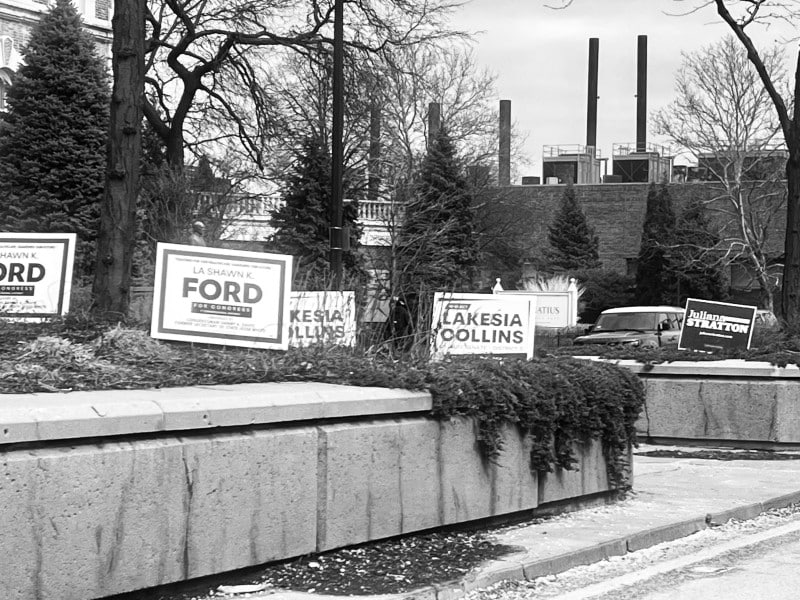
Chicago Outpaces Suburban Cook in Primary Turnout Despite Record Early Voting in the Suburbs
Election Day brought isolated polling-place issues but no widespread disruptions, officials said

Ford’s Suburban Edge Carries Him Past Conyears-Ervin in 7th District Democratic Primary
Franklin wins Ford’s old House seat; Stratton captures Senate primary as Hynes and Preckwinkle notch major Cook County victories
BALLOT POWER
A nonpartisan voter guide for the Greater West Side created with the help of the Westside Branch NAACP