West Side Residents Gather to Preserve Family Legacies at History Harvest
Event at Legler Library spotlighted new community archive; next session on Oct. 25 will tie stories to the Laramie State Bank redevelopment project.
West Side community members gathered at the Legler Regional Library, 115 S. Pulaski in West Garfield Park, on Oct. 11, to ensure that their family stories and neighborhood histories aren’t lost to time.
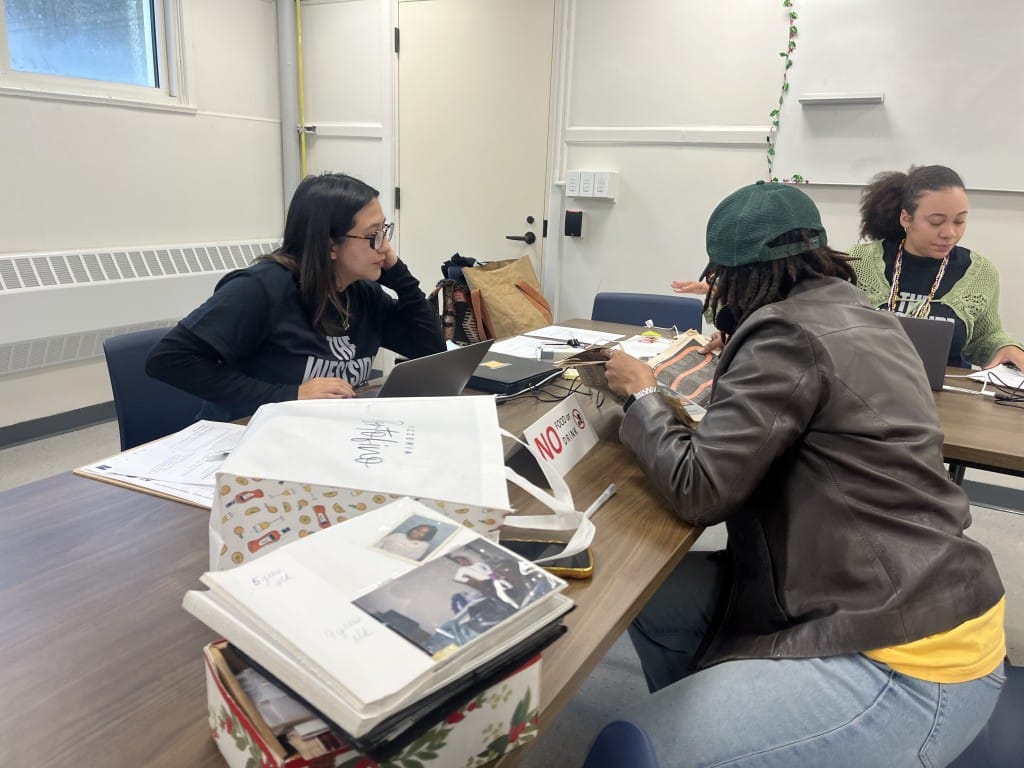
Hosted by the newly formed Westside Historical Collective, the “History Harvest: The Westside Family” event invited residents to bring old photographs, letters, and documents to be digitized, while also recording oral histories and taking portraits for a new community archive. The goal was to build a living archive of West Side stories that future generations can access and expand.
Throughout the day, residents circulated among scan stations, scrapbooking tables, and oral history booths. Experts from the Illinois State Archives offered photo preservation tips, while organizations such as the Chicago Film Archives, the Vivian G. Harsh Research Collection, and Dominican University’s Sacred Spaces Project hosted interactive exhibits on how families can care for and share their personal archives.
Nancy Watrous, founder of the Chicago Film Archives, said her nonprofit helps safeguard films that capture everyday Midwestern life.
“If you have home movies or know people with home movies and they’re from the Midwest, they can contact us and sign an agreement,” Watrous said. “We archive the films in our vault, get them digitized, and stream them on our website so future family members can have this material.”
Watrous’s organization is known for preserving the landmark 1971 documentary The Murder of Fred Hampton.
Photographer Kenn Cook Jr., an Austin native and 2025 artist-in-residence at Legler Library, leads the Westside Historical Collective. Cook and his team are working with Dominican University students to digitize the stories and photographs gathered during the event.
Community development professionals are also ensuring these archives inform future development. Jenna Pollack, community development manager at the Oak Park Regional Housing Center, said the material will feed directly into the Laramie State Bank Redevelopment Project—a historic mixed-use project on the Soul City Corridor at 5200 W. Chicago Ave. in Austin.
“We have a committee consisting of Kenn Cook Jr., Jordan Campbell, Keli Stewart, and Camille Wilson White, and part of their charge is to make sure that legacy Austin and current Austin residents’ history, culture, and current inclinations are at the center of the look, feel, and programming of the Bank project,” Pollack said.
“For those art and culture components, we’re using the archives we collect today and on Oct. 25 at alt_Space—people’s photos and records could be included on the fence, in murals, and throughout the residential and commercial spaces,” she said.
The redevelopment includes 78 new residential units, the first major housing development in Chicago’s 37th Ward in 50 years, set to open in spring 2026.
Among the partners present at the History Harvest was Honey Pot Performance, a Chicago-based creative collective behind the Chicago Black Social Culture Map — a digital, crowd-sourced project that documents spaces where Black Chicagoans have gathered for joy, art, and resistance for more than a century.
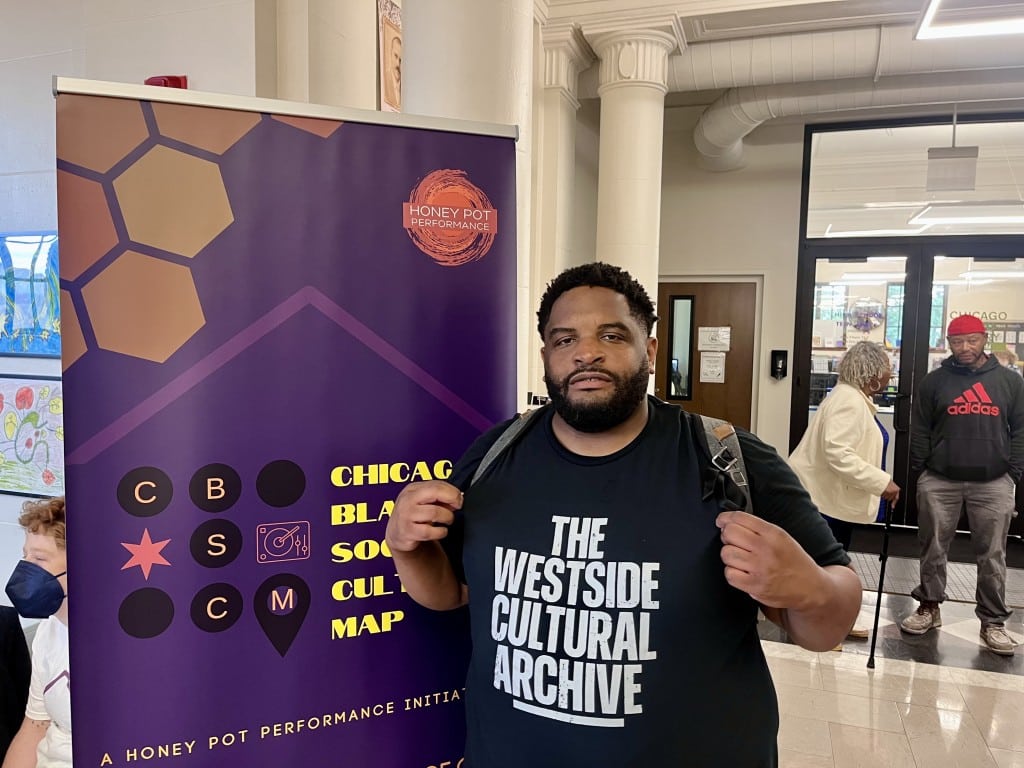
The map highlights everything from vintage nightclubs and roller rinks to churches and community centers, emphasizing how social spaces form the backbone of Black life in the city. By participating in the History Harvest, Honey Pot researchers helped connect local stories to this larger citywide effort to map Chicago’s cultural memory.
Two iconic community figures, Mary Nelson and Bernard Clay, were among those who shared firsthand accounts of decades of organizing on the West Side.
Nelson, 84, a founding member of Bethel New Life and a retired principal, recalled her early work with the Christian Action Ministry and the Westside Isaiah Plan, which united 13 churches to build energy-efficient housing.
“I just happened to be foot loose and fancy free at the time,” Nelson laughed. “I worked for zero dollars. The first houses we built guaranteed the heating bill would not exceed $200 a year.”
Clay, 74, founder of Introspect Youth Services, reflected on his early involvement in education and youth empowerment.
“I lived right around the corner, I stayed at Washington and Kildare,” he said. “CAM had one of the first Upward Bound programs in the country. They were founded in 1967.”
Next Steps: Community Archiving on the Soul City Corridor
The Westside Historical Collective will continue its archiving work on Oct. 25 from 11 a.m. to 3 p.m. at alt_Space, 5645 W. Corcoran Pl. in Austin.
The follow-up event—“Community Archiving on the Soul City Corridor”—is co-hosted by the Austin United Alliance Arts & Culture Committee and the Front Porch Arts Center. Residents are invited to bring photographs, documents, and family memorabilia for digitization. The materials may ultimately appear in the Laramie State Bank’s murals, exhibits, or outdoor installations.
For more information, contact frontporchartscenter@gmail.com or jennap@oprhc.org.
Related Articles
West Side NAACP Calls Community Meeting as CPS CEO Search Faces Scrutiny
The group is urging West Side residents to gather March 31 to talk about transparency and stability as CPS leadership search draws criticism amid uncertainty

Ford’s Suburban Edge Carries Him Past Conyears-Ervin in 7th District Democratic Primary
Franklin wins Ford’s old House seat; Stratton captures Senate primary as Hynes and Preckwinkle notch major Cook County victories
Kindred Civic Arts Forum Opens Women’s History Month With Cole Arthur Riley Conversation in Austin
Author of Black Liturgies and This Here Flesh reflects on Black interior life, spirituality, and emotional survival during a turbulent political moment